
| The following article is an in depth overview and a review of Axis & Allies Guadalcanal. Guadalcanal takes place in August 1942 during the conflict over the Solomon Island between the Japanese and Americans. This new game is a great addition to the Axs & Allies family of World War II strategy board games. |  |
Game Pieces
The game includes a total of 172 detailed miniature naval, air, and land units.
Americans units are green:
|
|
Japanese units are dark-orange-brown:
|
|
The game also includes: the battle box, 12 dice, 2 island base cards, 2 reference cards, the first player token, 2 victory track markers, 6 double sided control markers, 9 airfields, 10 American supply tokens, 10 Japanese supply tokens, 8 American advantage tokens, 8 Japanese advantage tokens, 10 red chips, and 60 grey chips.
For more details about the markers, read the preview of the Guadalcanal markers and tokens.
The game board itself has a high production value. It is tastefully colorful and the board has a nice slight glossy sheen to it.
 Setup
Setup
In addition to the game board, Guadalcanal also provides two home base cards, New Caledonia for the Americans and Rabaul for the Japanese. These cards are placed adjacent to the board as indicated on both the board and the cards. The home base card represents a far of island that will be used to deploy your reinforcements into the game.
One of the best improvements in the past few Axis & Allies games has been including unit setup directly on the board. Guadalcanal is no different, it provides a quick and easy setup with the silhouettes and quantities of each piece provided directly on the board and home base cards.
The Japanese player is the first player of the game and therefore receives the first player token. Whether you are the first player or the second player is extremely important in this game. The first player only has an advantage when using the submarine units. For almost every other situation the second player has the advantage due to the fact that they can react to the first players moves. This is advantage is somewhat minimized with how movement in the game works.
Winning the Game
The first player to 15 victory points at the end of the round wins the game. Victory points are scored immediately when you destroy a capital ship, battleship or aircraft carrier, and one point for each airfield is scored at the end of the round.If a tie of 15 or greaer is scored, the game continues until one player has more points than the other.
Phase 1: Movement
Relative to the other Axis & Allies games, one of the unique aspects of the movement in Guadalcanal is the alternating unit-type movement. Instead of one player moveing all of their units and the next player moving theirs, in this game, the first player moves a unit of a particular type and the second player moves that type of unit. The first player moves the next type of unit and then the second player and so on until all of the different units types have been moved. The order of unit movement is as follows:
- Load and move transports
- Move battleships
- Move aircraft carriers
- Move cruisers
- Load and move destroyers
- Move and attack with submarines
- Move bombers
- Move fighters

The trading off of moving each type of peice does a great job of keeping both players involved in the game at the same time. Unlike the original version of Axis & Allies, you cannot leave the room for 10 minutes while your opponent moves their pieces because as soon as they are done loading and moving their transports, you’re up next to move yours.
There are also a few strategic implications with regard to this movement methodology. First, you must plan in your head where you eventually want to place your other pieces. If you send your transports to attack an island, they might be destroyed in the water before they unload so you’ll need to escort them with other naval units. Second, you need to watch where you place your units. When you go first you don’t know where your opponent with muster the majority of his forces. By alternating you might be able to draw fire into one sea zone while you send your other forces elsewhere. This is a bit tricky to accomplish and your subterfuge become more evident as the movement steps proceed but it is a possibility. Finally, the first player has a great advantage with submarines. Since submarines move and attack, you can use them to take out any unit before it has a chance to be useful including enemy submarines. When a player is first, given the choice between an enemy cruiser and an enemy submarine, the submarine is the better choice, especially if it threatens your transports or aircraft carrier.
If you’ve played other Axis & Allies games, then you’ll need to know that there are some differences in movement. First, transports can hold any combination of 2 of the following: infantry, artillery, anti-aircraft, and supplies. Transports can also load units from different island zones. Next, fighters only have a range of 2 and bombers a range of 3 during the movement phase. During the regroup phase, however, these air units have the same range. Next, when aircraft carriers move, the fighters move with them on the carrier. The carrier move does not count against the planes movement. Finally, destroyers may load one unit or supply.
Phase 2: Combat
The combat phase consists of four steps:
- Attack air units
- Attack sea units
- Unload transports and destroyers
- Attack land units and/or airfields
For each attack atep, the first player determines which battle to roll first and rolls their attack. Next, the second play rolls their attack, and finally casualties are removed. Unlike classic Axis & Allies, the battle does not continue until one side wins. In fact, it is common for units from both sides to remain on the island at the end of the battle.
The staged attack sequence forces the player to think about consequences of moving units into particular situations. For instance, it might not be a good idea to send a lone bomber to attack an airfield is there is an anti-aircraft gun present because it has a good chance that it will be shot down before it has a chance to attack the land. Furthmore, you need to make sure that you protect your transports enough to allow them to land their units or else the consequences are costly. It is quite easy to needlessly lose units in this game when the player could clearly have avoided it in hindsight.
Another interesting feature of the game is that each unit has a air, sea, and land attack value. For many of the units some or all of these values are 0 but for the rest, they have the ability to attack in each attack phase for which they are eligible. For instance, during the “attack sea units” step an artillery unit can fire on an enemy unit into one adjacent sea zone. Likewise, a battleship or cruiser may fire into one adjacent island zone. Players should be aware of this and not forget to fire even if it is only one attack.
During the land attack phase, a player may choose to attack an airfield instead of any present enemy units. Attacking airfields an important strategic move becuase it both prevents your opponent from scoring victory points and also landing any aircraft in that airfield. You must score two hits to destroy an airfield.
Attacking with the Battle Box
To resolve combat, each 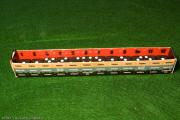 player much calculate the cumulative attack power of their unit attacking during the current attack sequence. It is possible for one player to have zero attack power and only the other player attack (this can happen to aircraft during sea battles). For instance, the Allied player has 2 destroyers and 1 cruiser in a sea zone and the Axis player has 1 battleship and 2 transports in the same sea zone. The attack power for the Allies is 4 and the attack power of the Axis is 3 (see the chart below). The attack power tell you how many dice in the battle box you are supposed to look at. The first player, let’s say the Allies player, takes the battle box, shakes it, let’s the dice settle into place, and pulls out the tray until the first 4 dice are showing. For each roll of a 1 or a 2 a hit is scored. To determine which unit was hit, look at the location of the 1 or 2 in the dice tray and line it up the the unit type listed on the outside of the tray (see images), that is the unit that was hit. If there is no unit of that type, then start from the front of the tray and name off each unit listed until you reach one that is present in the battle. Note: this aspect of the battle system means that for particular battles certain unit will be hit more often than others. After, the first player names off the casualties, the second player rolls their attack. When both players have rolled once each, the attack for that sequence/zone is complete and casualties are removed.
Ones and Twos
Under certain circumstances at result of a 1 or 2 will yield different results. When there are multiple transports or destroyers and some or all of these units are carrying units then you must pay attention to the hit roll result. On a result of 1 the attacker decides which of the units their opponent loses and on a roll of 2 the player losing the unit decides which to loose. Finally, when attacking a capital ship, Aircraft Carriers and Battleships, a result of a 1 means the unit is destroyed and a result of 2 means the unit is damaged. Note: battleships always ignore the first hit, whether it is a one or a two. Damaged units are not removed from the game, instead they are placed in the damaged area on the home base card.
Phase 3: Regroup
The final sequence is where the core of the planning for next turn comes into play. It is also when control of islands is determines and when victory points are assigned.
The regroup phase consists of the following steps:
- Determine control of island zones
- Land air units
- Build airfields
- Reinforce, repair, and deploy
- Score victory points and check for victory
- Pass the first player marker
Control of an island zone is determined by how much land power is currently exerted on it. Each player with land units on the island zone counts adds up the attack power of both their land units and also the land attack power of friendly naval units that are adjacent to said sea zone. For instance, if there is an infantry on Guadalcanal and a battleship adjacent to Guadalcanal, the attack power would be 3. Whichever player has the most attack power has control of the island.
When there are no more remaining enemy land units on the island sea zone, then the victorious player gains control of any airfields or supplies that were left on the island. This is important almost immediately in the game, since there are Japanese supplies on the Guadalcanal island zone.
 Landing air units is self-explanatory. Fighters move 2 and bombers move 3 during this phase. If there are no places for an air unit to land, then it is lost. Two air units of any type may land on airfields but only fighters may land on an aircraft carrier. If an airfield is destroyed, then a player may not land units on it.
Building airfields happens after you land your aircraft. Do not plan a flight plan with the intention of landing on a newly built airfield because it is just not allowed. To build an airfield you must have 2 supplies on the island sea zone. It is even possible to build an airfield that is controlled by your opponent just as long as you have some units and enough supply tokens. A player should not forget that a transport can only carry 2 supply tokens, you need another transport to deliver another supply.
Reinforce, repair, and deploy is the step when you introduce new units into the game. First you determine how many reinforcement points a player receives. In the rule book, you get a base of 5 points plus 2 for each island that a player controls. The rules errata, however, state that a player recieves a base of 10 plus 4 for each island zone. Having more reinforcement points makes the game slightly longer becuase there are more units in the game. The upside, however, is that players have more options for introducing new units.

Now each player must spend all of their reinforcement points to purchase units and supplies. After purchase units, eachh player places the units on their home base card. At this point infantry on the base card may be loaded into transports and fighters may be placed onto aircraft carriers.
Next, if a player has any units in the damaged box, that player may spend 1 supply token per damaged unit to repair them. Airfields are also repaired at this point. If an island zone has a damaged airfield and one or more supplies, the player can useone supply to repair that airfield.
Finally, another very interesting rule is deployment. After purchase and repair, a player may spend supply tokens to immediately deploy sea units directly onto the game board. The side adjacent to the home base card has numbers printed in each of the sea zones, that number is the amount of supplies the player can spend to deploy a single sea unit to that sea zone. This comes in very handy when you need to get units across the board fast to prevent or slow down an eminent win by your opponent.
Scoring victory is as simple as counting up the number of undamaged airfield each player has. Use the victory track to keep track of each players score. After victory points are tallied, be sure to check for victory.
Passing the first player token is the final step of the round.
Axis & Allies Guadalcanal will be available in stores on November
16, 2007 with an MSRP of $50 USD. For more details about the game
please read the following articles:
- Axis & Allies Guadalcanal Preview 1: Units
- Axis & Allies Guadalcanal Preview 2: Markers, Tokens, and Counters
- Axis & Allies Guadalcanal Preview 3: Combat and the Battle Box
- Guadalcanal Designer’s Notes: A Guadalcanal Diary by Larry Harris (Avalon Hill website)
- Guadalcanal Developer’s Notes Pt 1 (Avalon Hill)
- Guadalcanal Developer’s Notes Pt 2 (Avalon Hill)
- More Details for Axis & Allies Guadalcanal
- Axis & Allies Guadalcanal Product Details (Avalon Hill website)
All preview photos are copyrighted by this website, Axis and Allies.org, the logos, maps, artwork, and printed are copyright Avalon Hill, Wizards of the Coast, and Hasbro. If you wish to share a photo listed here, simply provide a link to the photo you wish to share.

