Axis & Allies .org Forums
    • Home
    • Categories
    • Recent
    • Popular
    • Users
    • Register
    • Login
    1. Home
    2. The Janus
    0%
    • Profile
    • Following 0
    • Followers 0
    • Topics 16
    • Posts 315
    • Best 73
    • Controversial 0
    • Groups 0

    The Janus

    @The Janus

    100
    Reputation
    301
    Profile views
    315
    Posts
    0
    Followers
    0
    Following
    Joined Last Online
    Location Alberta, Canada Age 25

    The Janus Unfollow Follow

    Best posts made by The Janus

    • RE: 👋 Introduce or Re-Introduce Yourself (Current)

      I’m not sure if it’s bad form to be posting in this thread after February ;) but anyway…

      My name is Janus (also known on other parts of the internet as P.d0t)
      I got into A&A with the MB version, back in about 1997 or so(?)
      However, the biggest chunk of my A&A play experience is/was with the Imp Games expansion “East & West”: https://boardgamegeek.com/boardgameexpansion/6441/east-west-global-war-1948

      That company seems to have gone defunct (and their forums went down long before that) so I joined the A&A .org forums a while ago – somewhat passively – but have been following the site’s news via Facebook. When the announcement for A&A Online came through on that channel, it rekindled my interest in E&W. As such, I’ve been trying to track down anyone who owns the game or has played it, and have been working on honing strategies for the USSR.

      One such strategy can be found here on the forums, which I ran just as a playtest against myself:
      https://www.axisandallies.org/forums/topic/19172/east-west-by-imp-games-soviet-strategy-playtest

      If you’re a fan of E&W, please get ahold of me here on the forums/PMs; it would be much appreciated :)

      posted in Welcome
      The JanusT
      The Janus
    • RE: Advice to Renegade! What is on your top 10 for adjustments to G40 3rd edition?

      @black_elk I think the way to do Italy justice is to just have a full-blown “Axis & Allies: North Africa” in the vein of the D-Day game.

      You could have German reinforcements come in waves sorta like D-Day, but more or less run the rest of the mechanics like A&A but with a cap on the number of rounds.

      posted in House Rules
      The JanusT
      The Janus
    • RE: Advice to Renegade! What is on your top 10 for adjustments to G40 3rd edition?

      @black_elk said in Advice to Renegade! What is on your top 10 for adjustments to G40 3rd edition?:

      I tend to agree with most of the points Janus is making about streamlining the game. I think the prob comes from low-balling the money and trying to keep those numbers so low, instead of just amping the production a bit.

      After reading the thread saying “infantry should cost 3.2!” this idea popped into my head: increase the IPC values and unit costs by 10x except for infantry – which would then cost 32.

      In that same vein, I think if you want to have a game with more and more unit types, they should look at doing a move to d10 (as was done with Napoleon’s Imperium.) Having infantry at A1|D3 on a d10 might help negate the IPM.

      posted in House Rules
      The JanusT
      The Janus
    • RE: "East & West" by Imp Games - Discussion

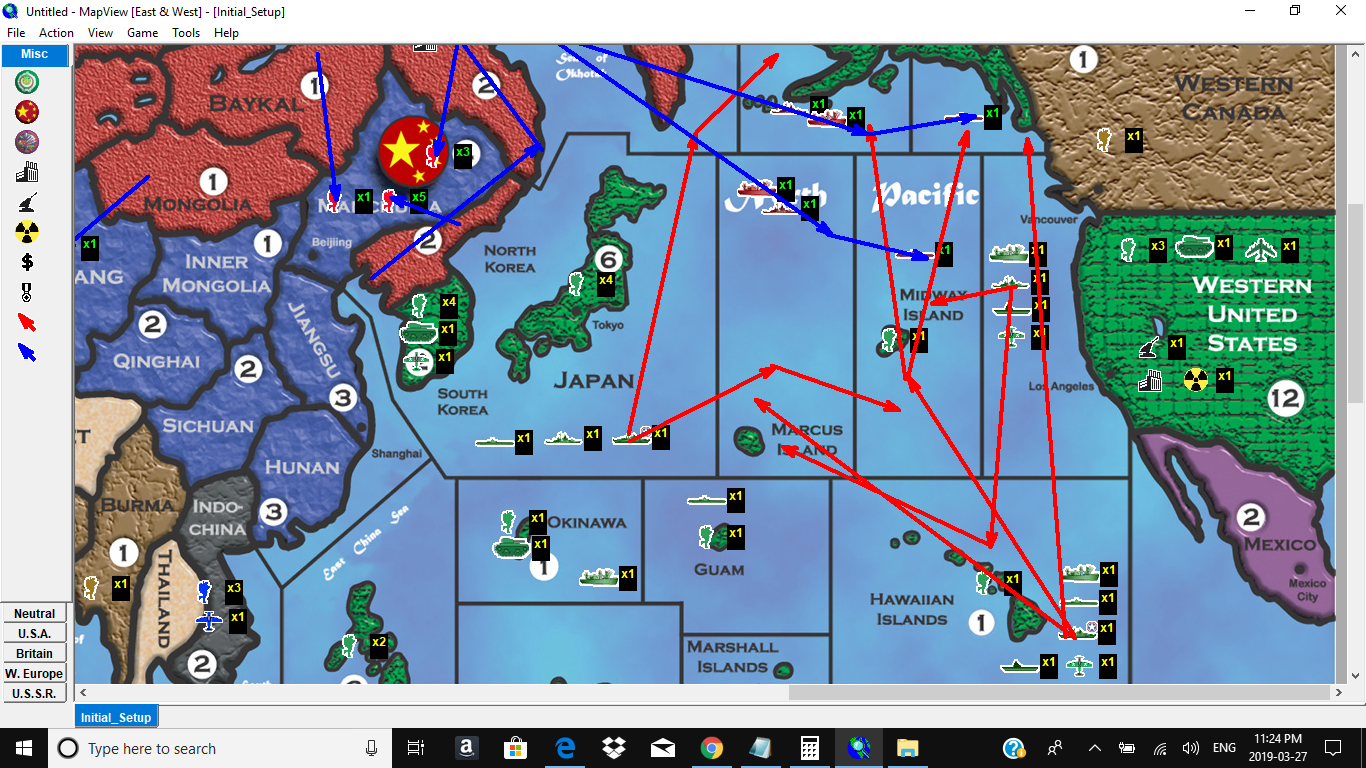
      Tactics: Operation Fishnet (Soviet Pacific Fleet)

      For those who know me, I’ve historically mostly played as NATO in E&W. As part of the ongoing refinement of my Soviet strategy, I wanted to come up with some better opening moves for their naval units; here’s what I’ve been looking at just recently:
      (red arrows outline spaces that US navies could conceivably reach)
      6c58f165-9e4d-4054-afc3-cd4df2ae99b7-image.png

      Objectives: To stall US transport capability in the Pacific.

      This should be a fairly straightforwardly important goal, for any Soviet player: keeping the US off of your shores (or away from landing support into SE Asia.) It’s difficult to actually attack the US transports (because of their positioning) so instead we want to prevent them from steaming across the ocean, for as long as possible.

      Scatter
      The purpose of scattering your navy is to make it a less-attractive target for the US nuke. Many times, the Soviet moves in the Pacific involve slamming as much force as possible against another large force. Usually this is a no-win situation; either your remaining force is large enough to warrant dropping the bomb on, or is small enough that it is mopped up by US naval forces, with nary a whimper. Also, keeping subs separate from surface ships will tempt your opponent to split their air power from their naval power.

      Block
      By positioning the subs between your other ships, and the West US fleet, you’re able to effectively keep those units from using their full movement – unless the enemy attacks both ranks of your defensive line. Again, this is not the worst result, because you’ll have already prevented them from being able to concentrate their forces.
      If the Japan SZ fleet attacks the Soviet ships in the Bering Strait, this means that the transport at Okinawa cannot effectively be used to amphibiously assault Kamchatka or East Siberia; the ships at Hawaii are also blocked from providing shore bombardment, and the carrier cannot move in to provide a landing space for supporting fighter aircraft.

      Deadzone
      As you’ll note on the map, the Marcus Island SZ can potentially be hit by all of the US ships in the area. However, if the US moves heavily into this zone with their surface fleet, they will not be able to keep the Japan SZ well-defended – potentially leaving it open to a counter-attack, with support from Soviet aircraft. If they instead consolidate their navy at Marcus Island, their transports will be far out of position to send reinforcements to SE Asia.
      The place where the US can launch the strongest amphibious assault (with both their Japan fleet and Hawaii fleet) is against North Korea. Fortunately, the free Chinese infantry make this a tough nut to crack, and the Soviets should always have units in East Siberia and/or Manchuria, available for a counter-attack. Also, the commitment of US surface ships to such an attack would mean a much weaker naval response, to the Soviet fleets; if the US only commits submarines to Marcus Island, and only aircraft to deal with the Soviet submarines, they risk leaving the West US transport exposed to the Bering Strait ships. In this situation, the US may opt to instead move this transport towards the Panama Canal – both to be out of reach, and to instead assist in moving forces to Europe. In this case, the Soviet fleet will have succeeded at its objective.

      Let me know what you think about this opening move :)
      Comments and critiques are always welcome!

      posted in Other Axis & Allies Variants
      The JanusT
      The Janus
    • Units, Mechanics, etc.

      I’m kind of an old skool, Classic-ish grognard; I’ve been poking around with the Europe 1940 game (in TripleA, against the ai) mainly as the Allies, but a little bit as Italy.

      I guess my question is, which units should each country purchase?

      For example, I’ve found that the UK can make use of subs against Italy’s surface fleet (although I guess I’m a n00b for not just YOLO’ing and blowing them up with all of the UK’s planes, on rd1.) But generally, it seems like no one should really want/need to build any navy other than destroyers, transports, and carriers (with aircraft to go on them). Destroyers just do everything…

      Is there any sense in bringing along extra carriers, i.e. more than just enough to hold your planes, in case one gets sunk? Why are carriers 2-hit anyway, if they’re effectively useless after the first hit? Are there any good spots to put down new airfields, or is scrambling underused in the Europe map, and really only applies to the Pacific?

      I don’t find artillery all that helpful; if you’re the US for example, you have the cash to build tanks, and if your intention is just to send as much stuff as possible to the USSR, then you want units that can race across North Africa quicker. I think for poorer countries, artillery makes sense but even as Italy I tend to go all infantry, and as USSR I maybe crank out 1 artillery per round; if you can get your income up, tanks seem way more helpful for counter-attacking in and around Novosibirsk, while using your planes to clean up along the main front line.

      What circumstances do people use mech. infantry in? Honestly, I rarely buy it other than to place at an Allied factory in Persia, Norway, or similar/nearby territories (Greece, Turkey, Finland). I particularly can’t justify putting one on a transport, instead of a tank (or even possibly an artillery.) I’ve heard that it’s a good unit for the Axis, on defense…

      I guess I just feel like there’s a lot of chrome/cruft to this version of A&A, and I believe it could improve by being stripped down a little.

      posted in Axis & Allies Europe 1940
      The JanusT
      The Janus
    • RE: 1941 "limited" scenario for A&A Classic

      Turn Order:
      (With the intention of keeping as close to the original turn order, while still slotting in the added countries)

      1. USSR
      2. a) Italy (and Vichy France)
        b) Germany
      3. a) UK (Atlantic)
        b) China (includes India, Dutch, ANZAC, etc.)
      4. Japan
      5. a) US Pacific
        b) US Atlantic

      Round Zero / “Impulse”:
      Prior to the first full round, the Axis get one round to act. This should be played out in the turn order described above, omitting the Allied turns.

      The Axis conduct all phases of their turns during this round, with some very important bonuses added:

      • Infantry & Armor: attack power is increased by 2, costs are reduced by 1 IPC
      • Fighters & Bombers: attack with 2 dice instead of 1, costs are reduced by 2 IPC
      • Naval units: attack power is increased by 1, costs are reduced by half

      During this round, Allied units defend as per normal, with one notable exception: since they are not yet at war, AA guns belonging to the USSR and USA do not fire.

      Axis Advantage / “Russia Restricted”
      On the first round, the USSR and the US (both Atlantic and Pacific) may only conduct the following phases of their turns: Purchase Units, Place Units, Collect Income.

      In addition to the bonuses on Round Zero, all three Axis countries gain these benefits:

      • all Axis battleships are 2-hit battleships
      • all Axis powers have Super Submarine technology
      • all Axis powers have Jet Power technology

      Setup & Territorial Changes:
      The original setup for Classic is used, however changes in ownership of a territory also govern changes in the nationality of ALL units listed for that territory (including naval units) with the following exceptions:

      • All German naval units are given to Italy (including any newly purchased units)
      • All Soviet naval units are given to the UK; the USSR may not produce naval units in this scenario

      45d781be-417a-41b8-9b35-f20d24a4fed4-image.png

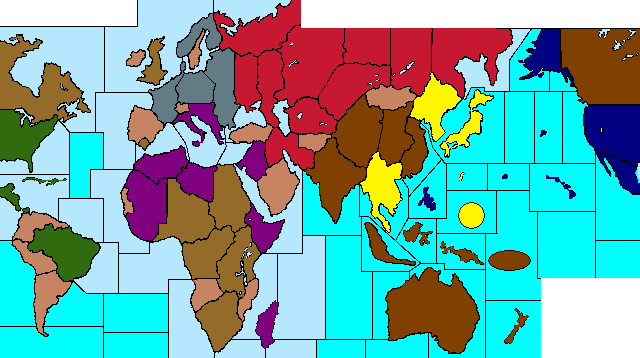
      As you can see from the map above, the sea zones are broken down into two sections:

      1. those bordering the territories of USSR, Germany, Italy, UK, and US Atlantic – to be used only by the navies and air forces of those countries
      2. all other sea zones – to be used by the navies and air forces of China, Japan, and US Pacific

      You’ll note that this limitation creates one sea zone in the mid-Atlantic which is effectively impassable; feel free to adjudicate this differently, if you find a change to be helpful.


      Industrial Complexes / “Victory Cities”:
      Add an AA gun and Industrial Complex to the following territories:

      • Ukraine SSR
      • South Africa
      • India
      • Australia

      No new industrial complexes may be built.

      In this scenario, the number of units a complex can produce is limited to the IPC value of the territory in which it is located (including capitols.) As such, you may only purchase a number of units up to the total IPC value of the industrial complexes which you have controlled since the start of your turn. For example: the UK has an industrial complex on their capitol (8 IPCs) as well as in South Africa (2 IPCs) meaning they can purchase a maximum of 10 units on their turn.

      Further to this, the number of naval units you may purchase is limited not only to the IPC value of your coastal/island complexes, but also by whether the adjacent sea zones are clear of enemy ships. For example: Since Japan only has an industrial complex in their capitol, if the islands are surrounded by Allied naval units at the start of the Japanese turn, Japan may not purchase any naval units on that turn.

      A nation who loses their capitol may continue to collect IPCs from any territories they still control, provided they also still control at least one industrial complex after the Combat Phase of their turn. If a nation controls no industrial complexes after any nation’s Combat Phase, they must surrender their IPCs to the nation whose turn it currently is. They also can no longer collect IPCs, until they regain control of at least one industrial complex.

      Victory is achieved when either side controls at least “2 out of 3” Axis and “2 out of 3” Allied starting Industrial Complexes (8 Industrial Complexes in total) at the end of any round of play.

      Theatres of War
      It is intended that each theatre may be played separately, as their own sort of “mini-game” but they may also be played in concert, and merge together under certain circumstances of victory or defeat. A nation may not attack nor move units into any territory which is not a part of their theatre, until those theatres merge together.

      • Atlantic Theatre: UK, Italy, US Atlantic
      • European Theatre: USSR, Germany
      • Pacific Theatre: China, Japan, US Pacific

      If Germany or Italy collects an income of at least 5 IPCs less than their starting income, the Atlantic and European theatres merge at the start of the following round. This also happens if Germany collects an income of at least 10 IPCs more than their starting income.

      If Italy or Japan collects an income of at least 10 IPCs more than their starting income, the Atlantic and Pacific theatres merge at the start of the following round. This also happens if Japan collects an income of at least 5 IPCs less than their starting income.

      If playing any theatre individually, the Axis country wins if they collect an income of at least 15 IPCs more than their starting income; the Allies win if the Axis country collects no income.

      Starting Incomes:

      1. USSR - 28 IPCs
      2. a) Italy - 12 IPCs
        b) Germany - 21 IPCs
      3. a) UK - 18 IPCs
        b) China - 18 IPCs
      4. Japan - 15 IPCs
      5. a) US Pacific - 18 IPCs
        b) US Atlantic - 17 IPCs

      Mergers and Restrictions
      Whenever the European and Atlantic theatres merge, Germany and Italy combine their cash on hand, and effectively become one nation.

      Whenever the Atlantic and Pacific theatres merge, the same happens with the UK and China, as well as with US Atlantic and US Pacific. Additionally, when this merger takes place, the restrictions on naval movement end; the navies of all nations can enter any sea zones on the map.

      Unlike most global Axis & Allies games, in this scenario Japan and the USSR may never attack each others’ territories or naval units. However, if the Pacific and European theatres have merged (i.e. all 3 theatres must have merged, for this to happen) the following actions are permitted:

      • Soviet units may enter Allied-controlled territories (such as those belonging to China)
      • Japan may destroy Soviet units in Allied-controlled territories, on Allied aircraft carriers, or aboard Allied transports.

      Other Recommended Rules

      1. No invading neutrals
      2. No technology advancement

      I’ve decided to leave out most of the “errata”-type changes I had written up in my earlier draft, since those are mostly down to a matter of taste; generally sticking to the 2nd Edition rules will be perfectly fine. But if anyone is interested, I’ll be happy to add those to the thread.


      If you have any questions or comments, please post them down below :)

      posted in House Rules
      The JanusT
      The Janus
    • RE: "East & West" by Imp Games - Discussion

      @tacojohn said in "East & West" by Imp Games - Discussion:

      Yeah, it might be that. But right now, the only TGW map is in MapView, right?

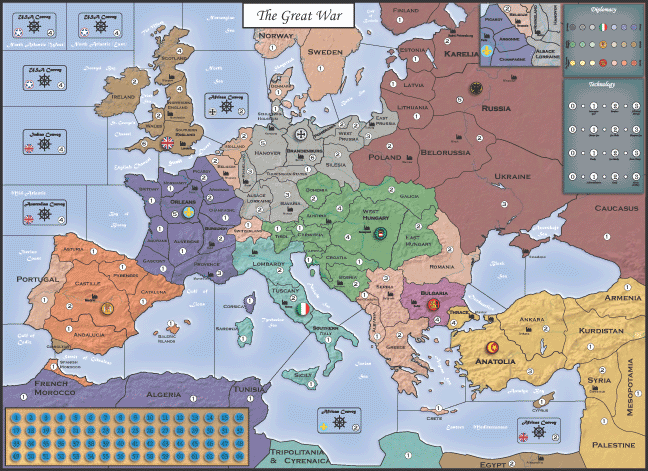
      FWIW, I was able to dig this out of archive.org, from the Imp Games website; I probably have it saved somewhere, but it was just quicker to dig it out that way. (Obviously not high-res, but was freely available online, when the site was up.)
      The Great War (small file).gif

      posted in Other Axis & Allies Variants
      The JanusT
      The Janus
    • RE: Advice to Renegade! What is on your top 10 for adjustments to G40 3rd edition?

      @hengst I mean if you’re building a game where your baseline assumption is that Germany would/should be overpowered, then sure :face_with_rolling_eyes:

      Edit: To clarify my point, I think one of the things that works to keep Germany competitive is that the Allies don’t get to attack them together. Even then, their job tends to be “don’t die, until Japan sweeps the board.” If you take that disadvantage and give it to Germany by splitting their economy and units into smaller chunks, it’s not actually a benefit to them. And I think if the only justification for doing it is to have a 3v3, I feel like the juice isn’t worth the squeeze.

      posted in House Rules
      The JanusT
      The Janus
    • RE: "East & West" by Imp Games - Discussion

      Our intrepid Axis & Allies player @The_Good_Captain has put out a video which includes a review of East & West!
      https://www.youtube.com/watch?v=lsm4is72-sc

      I’m about to check it out myself; I’ll let the crowd know if I have any thoughts on it :)

      posted in Other Axis & Allies Variants
      The JanusT
      The Janus
    • RE: Advice to Renegade! What is on your top 10 for adjustments to G40 3rd edition?

      @hengst I guess my point is that you don’t make the Axis more interesting by splitting Germany into a moderate power and a minor power; I think you can do that more effectively by making Germany a proper superpower.

      And like I said, any timeframe later than 1940 makes it harder and harder to justify Italy being a separate power, unless your idea is that their main contribution is to be an “also-ran” on the eastern front, as part of a bloc with the other minor powers. It just doesn’t vibe, IMO.

      posted in House Rules
      The JanusT
      The Janus

    Latest posts made by The Janus

    • RE: "East & West" by Imp Games - Discussion

      @The_Good_Captain I should be able to. If you don’t see me around the forums, hit me up on Discord.

      posted in Other Axis & Allies Variants
      The JanusT
      The Janus
    • RE: Advice to Renegade! What is on your top 10 for adjustments to G40 3rd edition?

      My other gripe is that the UK is far too weak, and as a result, the decision to effectively have them split into 3 factions seems like a huge mistake.

      posted in House Rules
      The JanusT
      The Janus
    • RE: Advice to Renegade! What is on your top 10 for adjustments to G40 3rd edition?

      @ampdrive
      Having played a bit vs. @Aardwolf44 the problem with the game is that the Germans have enough air force to take out the entire British navy and swing into Africa to make the Italian defense impenetrable… and absolute dumpster the USSR; VCs fall way too quick for the allies to be able to do anything

      posted in House Rules
      The JanusT
      The Janus
    • RE: Advice to Renegade! What is on your top 10 for adjustments to G40 3rd edition?

      @crockett36
      How much of the German air force can France take out on F1?

      If the answer is “zero” then I’m not interested.

      posted in House Rules
      The JanusT
      The Janus
    • RE: Advice to Renegade! What is on your top 10 for adjustments to G40 3rd edition?

      @Imperious-Leader said in Advice to Renegade! What is on your top 10 for adjustments to G40 3rd edition?:

      start 1939, not 1940,

      I think France is such a non-entity in the game, that even the 1940 start is too early. I think the only way something like that works is if you have a game that ends around the time the USSR would be invaded… which might work for a Europe game, but not a Global game.

      People forget that Xeno Games’ World At War (in a lot of ways) was the answer to the question of “What if we did A&A but in 1939 and with France as a major power?” I think G40 actually took a lot of the lessons from that, while still throwing a bone to France, despite itself.

      posted in House Rules
      The JanusT
      The Janus
    • RE: "East & West" by Imp Games - Discussion

      Part Five:

      Errata & Optional Rules: Discussion

      Upon reviewing the rules a bit, naturally the ones that stick out and cause problems are the ones that don’t pertain to RISK’s core combat mechanics.

      Indonesia

      Let’s say the USSR attacks the Arab League: Indonesia is supposed to stay neutral in this case, but can NATO still influence them, somehow? Does WE have to be the one to do it, or could it be UK? The ‘quick and dirty’ solution would just be to reverse the rule treating Indonesia as a separate entity, and say that the territory sides with NATO, if the Arab League is attacked by the USSR. Since they are aligned with WE, their troops should be replaced with WE (blue) troops, if/when this happens.

      An obvious optional rule in this situation might be that Arab League territories join WE but Indonesia joins the UK; chalk this up to representing Singapore, Malaya, etc. or just with the continent of Australia being aligned with UK, in this game.

      The alternate solution is to clarify the rule to be “an attack on Indonesia is not treated as an attack on the Arab League, but an attack on the Arab League DOES count as an attack on Indonesia.” I think this probably most closely reflects the intention of the mechanics.

      Edit: Given some more time to stew over it, I feel another good simplification might be to allow WE to continue using their influence roll (converting Indonesia on a success) in the event that the USSR takes out the Arab League.

      Possibly a better (albeit more complicated) solution would be to allow NATO to use their influence roll towards their affiliated neutral alliance OR towards Indonesia. If they successfully influence Indonesia, they would replace Indonesia’s troops with their own. This treats Indonesia more like a “minor neutral” such as they would be in E&W; the reason I don’t like this is that it creates a new set of rules around a single territory, instead of just conforming to the existing/general rules.

      Since the USSR has the option to ATTACK Indonesia, they can always gain the territory that way; this rule would simply address the fact that NATO does not have such a mechanism to gain the territory.
      I should probably mention in this space that allowing NATO to use its influence roll to gain Indonesia, would allow for the possibility of the US gaining the territory. This would be an interesting wrinkle, as I’ve often said that in classic E&W the US needs to be able to gain Thailand in the event that the USSR goes nuclear; this would sort of serve to simulate that scenario, of the US needing to use its influence to try and gain a base of operations on mainland Eurasia.

      Influence

      Since the opening-game balance is presupposed around the OAS being at +1 to US and China being at +1 to the USSR, the obvious optional rule to include would be one not allowing diplomacy until the 2nd round of play. This would reflect the mechanical realities in E&W, of everybody starting the game with no spies in play (barring the USSR spending their “round zero” mobilization cash on spies.)

      The rule limiting NATO to influencing only their affiliated neutral could also be changed… Although it might have to be limited to “once you’re already receiving +2 from them” to prevent dogpiling.
      The intention of the limitation is to keep the game simple and fast; it’s also meant to avoid some of the pitfalls of E&W’s system, whereby there’s really only one correct choice, so just hammer that option as early and often as possible.

      Nukes vs. Capitols

      An interesting thing with the mechanic of nuclear weapons being added to a RISK game, is that it creates the possibility of a territory being cleared of armies. Since armies are used to denote territory ownership (serving the function performed by control markers, in A&A-type games) it stands to reason that a territory with no armies on it is controlled by no one. But what if the territory has a capitol on it?

      This is an interesting thing, because the existence of a capitol implies ownership of the territory, corresponding to a specific faction, without there being troops in the territory (i.e. which would be the normal way to denote ownership of the territory.)

      Obviously, a territory with a city but no armies is not controlled by anyone; this makes targeting cities with nukes more appealing, since it doubles the loss in “income” – similar to how targeting Industrial Complexes with nukes in E&W effectively doubles the reduction in infantry production, on that territory.

      So the questions seem to be:

      1. Can you place troops on your capitol, if there are currently no troops there?
      2. Do you get credit for “controlling” your capitol, if there are no troops in its territory?
      3. Does your capitol allow you to get credit for “controlling” the territory it resides in (including the bonus for a city)?

      I think my answers to these would be: yes, maybe, and no (respectively.)

      If a nuke wipes all of the armies off of a territory without a capitol, my general assumption was that this works the same as if a nuke in E&W reduced the IPC value of the territory to zero – meaning it cannot produce any infantry. The question then is, do capitols provide some immunity to this? Does not providing this immunity make nuking capitols (exclusively) too powerful in the overall meta? Again, these would have to be born out with more playtesting.

      Edit: Since I’ve said earlier in the thread that NATO factions would still get credit for their own capitol even if the territory is controlled by an ally… if there are no armies on your capitol, I think you would still get credit for controlling your capitol in that scenario as well. This changes my answer to #2 from a “maybe” to a “yes”
      Normally, you have to have your armies in a territory in order to get the benefits of controlling said territory, but we’ve already made this one exception for liberated capitols, so it makes little sense to treat an empty capitol differently; essentially we are saying you always get credit for your capitol, as long as it is not held by your enemy.
      Similarly, for question #3 – if your ally liberates your capitol, that ally gets the credit for controlling the territory (and its city) but not the capitol. If no side controls your capitol, no side gets credit for that territory or its city, but you still get credit for your capitol. As such, the control by armies determines who gets credit for territories/cities; control of capitols is made into a binary between friendly/hostile.

      Addendum: The answer to question #1 being “yes” makes for the specific stipulation that only in the case of a territory being empty of armies, does your capitol imply ownership of said territory – but this is only for the purposes of troop placement, not troop “drafting”. If nuking a capitol and eliminating all armies there meant that you could not get credit for the territory/city, or the capitol, and that you could not place armies there…? Then this tactic would be way too powerful. I think allowing the owner of the capitol to spawn new troops in the territory (if it is empty) makes it a less desirable target than to just wipe out all of the armies in a territory with a city, but no capitol. This might be slightly over-tuned, and maybe simply allowing them credit for the capitol might be enough, but for now I like the idea that this can be one special thing that capitols can do.

      posted in Other Axis & Allies Variants
      The JanusT
      The Janus
    • RE: "East & West" by Imp Games - Discussion

      Part Four:

      FAQ / Q&A?

      For anyone who has been reading along, I’ve made a few edits here and there to the preceding posts, as things popped into my mind. So before asking any questions, maybe do one more read-through to make sure I haven’t covered it, since the original time of posting.

      If there are any further additions/clarifications need, I’ll try and keep them consolidated into this post.


      Q1. Basic Setup: why?

      @The-Janus said in "East & West" by Imp Games - Discussion:

      Now, if memory serves, I think the idea with the starting forces was to use only the number of infantry for each country, and sort of rounding those numbers off.
      […]
      After putting 1 army onto each of your starting territories, count out 60 red armies for the USSR, 30 green armies for the US, 25 yellow armies for the UK, and 20 blue armies for WE.

      Including the single armies placed onto each starting territory, the number of armies in this mod vs. the number of infantry in ‘classic’ E&W works out to:
      USSR: 68 vs. 60
      WE: 28 vs. 28
      UK: 35 vs. 31
      US: 36 vs. 33

      Now, if you account for the “round 0” IPCs for the USSR being spent all on infantry, this would raise their starting number to 70 in E&W.
      Overall, I like how the numbers work out, in terms of it showing that US > UK > WE
      I would also argue that the USSR going first helps to balance off the fact that the US doesn’t have any units in poorly-defended front line positions (such as in West Germany) in the RISK game.

      As has been discussed in the E&W thread before, the only real discrepancy in units between the two sides (particularly after the first round of battles has happened) is in naval units and bombers; I feel like simplifying the calculation down by only using the infantry numbers saves a lot of overhead.


      Q2. The USSR runs out of armies, on their first turn! What do?

      Ok, so as I mentioned there are 80 armies for each colour, in the Reinvention version of RISK; the USSR starts with 68, and since they go first they will draft their full complement of troops (i.e. no loss of ‘income’ from NATO attacks) – in this case 14, once you include China. So that starts the game with a total of 82 for the USSR.

      You’d also want 1 red army to be placed on China’s city, in Mongolia to denote the +1 contribution – so that would bring the number up to 83 army markers that the USSR has to spread around.

      I’m sure in testing, I probably just used a couple of the black armies to make up the difference (keeping in mind that there should be 5 of those to spare.)

      There’s little incentive for the USSR not to attack multiple places on their first turn, so killing off the 2-3 extra armies (and then some) should be no issue. Because this isn’t “every man for himself” (with some diplomacy involved) the way a typical RISK game would be, you really only have one opponent, and your objective is to kill each other.

      The first round is typically a bloodbath, because of the fact that WE has to split focus between defending their capitol and keeping the USSR out of Africa, UK has to try and defend their capitol while also keeping India viable, and the US has to put a heavy presence in the Pacific or risk being blocked from attacking at all.

      Addendum to this addendum: This all probably formalizes the idea that the influence rolls should be skipped until the 2nd round of play. Also, if the USSR needs to “borrow” 3 armies from the pool of 5 spare neutral armies, this leaves 2 extra armies in total; it might be worthwhile to just add one of those to each Chinese territory, bringing their total per territory up to 16 armies. (Coincidentally, that’s the IPC value of China, in classic E&W.)


      Q3. What if a nuclear attack complication is supposed to result in Outrage, but the Arab League is already dead?

      (Working from the assumption that invading the Arab League doesn’t immediately cause Indonesia to join the opposing side…)

      If Indonesia is still neutral, I would say that this result should push Indonesia into joining the opposite side of the one making the nuclear attack.

      So, for example, if the USSR targets WE with a nuke, the outrage is supposed to push the Arab League / Indonesia towards WE; if the Arab League is still neutral, it would push them to +1 (including counting Indonesia’s territory, for the purposes of WE’s income.) In the same situation, but where the USSR has already invaded the Arab League, the outrage should instead cause Indonesia to join WE.

      The other example would be a nuclear attack against a neutral, in which case all other neutrals are supposed to swing 1 point against the aggressor. In this scenario (with the Arab League already invaded) I would say that Indonesia would join the opposite side, including the possibility of Indonesia joining the USSR. This would only be in the unlikely case of NATO making a nuclear attack against a neutral, which can only take place if that neutral (for example, maybe China) is supporting the USSR at a +2 level.

      posted in Other Axis & Allies Variants
      The JanusT
      The Janus
    • RE: "East & West" by Imp Games - Discussion

      Part Three:

      Victory Conditions

      Obviously a bunch of mechanics tend to fall apart (particularly pertaining to neutrals and influence and such) if a NATO power is completely wiped off of the map…

      So that’s basically the win condition for the USSR – to eliminate (at least) one of the NATO powers. 2nd option is just taking the US capitol. 3rd option is for USSR to be controlling at least 3 continents. All 3 victory conditions require that the USSR still controls their own capitol.

      NATO VC’s are:
      a) controlling 5 continents, including all NATO capitols
      b) controlling all 4 capitols

      Most of the caveats pertaining to capitols were, obviously, added in with the Reinvention version of this mod. I felt it helps to make them important, the same way that they are in E&W.

      Basic assumption for these win conditions (pertaining to continents) would be that NATO controls everything except Asia, and USSR would control Europe, Asia, and one other (likely Africa or Australia.) Neutral contributions would count towards control of continents, so they are not necessarily required to be conquered.

      Neutral Notes

      Fun fact: Reinvention only ships with 5 colours of armies, unlike the typical 6 you could expect in earlier versions.

      In case it needed to be said, all neutral armies are meant to be represented using the black armies; the black capitol is not used in the E&W scenario.
      The territories for neutrals (I would hope) are pretty obvious, too…

      • OAS: Central America, Venezuela, Peru, Argentina, Brazil
      • Arab League: Egypt, Middle East
      • China: Mongolia, China

      As in E&W, if a neutral is attacked and not completely destroyed, their remaining armies are replaced with those of the power they become aligned with (i.e. USSR, if attacked by NATO; if attacked by USSR, OAS joins US, Arab League and Indonesia join WE, China joins UK.)

      Liberating Capitols

      As per the normal Reinvention ruleset, you get 1 army for each capitol you control. My sense is that in the E&W mod, a capitol owned by one NATO partner but liberated by another NATO partner should still contribute its 1 army to the original owner… but I’m willing to have my mind changed on that, depending on playtesting/feedback.

      Trading in Cards

      I’ve always liked the rule that you can get 2 additional armies on (at least one of) the territories corresponding to the cards you trade in, if you control that territory. In the Reinvention rules, you can basically turn in as few as 1 and as many as 5 cards at a time; for this reason, I feel like a good compromise is just to say, “you gain 1 free additional army on any territories you control, corresponding to the cards you trade in.”

      posted in Other Axis & Allies Variants
      The JanusT
      The Janus
    • RE: "East & West" by Imp Games - Discussion

      Part Two:

      Basic Setup

      Now, if memory serves, I think the idea with the starting forces was to use only the number of infantry for each country, and sort of rounding those numbers off.
      Since the starting territories are pre-set, there isn’t the “claiming territories” phase from the original game. But to simulate something similar, the placement is done in a “you go-I go” fashion.

      After putting 1 army onto each of your starting territories, count out 60 red armies for the USSR, 30 green armies for the US, 25 yellow armies for the UK, and 20 blue armies for WE. Then, take turns placing those armies over 5 rounds, as follows:

      • 3 Soviet
      • 4 WE
      • 3 Soviet
      • 5 UK
      • 3 Soviet
      • 6 US
      • 3 Soviet

      Starting Territories

      Some of the names are changed from earlier versions of RISK, but for the sake of uniformity, I have used the territory names as they appear in the Reinvention version.

      USSR: Northern Europe, Russia, Urals, Afghanistan, Siberia, Yakutsk, Irkutsk, Kamchatka
      WE: Western Europe, Scandinavia, Southern Europe, North Africa, Central Africa, Madagascar, Southeast Asia, New Guinea
      UK: Great Britain, Northwest Territory, Alberta, Ontario, Eastern Canada, East Africa, South Africa, India, Western Australia, Eastern Australia
      US: Eastern United States, Western United States, Alaska, Greenland, Iceland, Japan

      There’s an argument to be made that Northern Europe could be given to WE. The problem is that it leads to kind of a boring opener for the USSR, because the obvious thing is to just heavily stack in Russia (aka Ukraine). Giving the USSR control of Northern Europe gives them more options for how they can position their start… but also this gives NATO a bit more information as to their intentions than the situation of just, “I stack everything in Russia; you’ll find out which of the 3 lanes I’ll attack when it’s my turn.”
      It also means that the USSR is “open” to attack from the UK, in Europe, right out of the gate – rather than being able to possibly avoid such contact by routing through Southern Europe, into Africa

      Balancing / Rationale

      Not counting capitols, here’s what everyone would start with (before any attacks)

      WE: starts with 8 territories and 1 city, so that makes for 3 armies
      UK: starts with 10 territories and 2 cities, so that makes for 4 armies
      US: starts with 6 territories and 2 cities + 5 territories and 1 city (for the OAS contribution) = 14 / 3 = 4 armies; adding in one continent bonus means either 5 armies for North America, or 2 for South America
      USSR: 8 territories and 3 cities + 2 territories and 1 city (for China’s contributions) = 14 armies

      Once you add in capitols, that makes it 19 for NATO vs. 15 for USSR – however, keep in mind that the USSR can break North America to cut NATO’s number down by 3; losing any 1 territory would reduce WE or UK’s production by 1 army – 2 if it’s their capitol. Barring some extreme results from influence rolls, the opening of the game has the potential to be pretty balanced.

      The OAS contribution to the US feels out of place w/r/t how it typically plays out in E&W. However, to balance off the massive number of territories the UK has, with how few the US should have…? I’m not sure there’s a better solution, within the RISK framework. Even the possibility of OAS territories counting for double at a +2 contribution doesn’t make for a huge swing, since this bonus works out to only 4 armies.

      Nuclear Weapons

      I mentioned before that the blank cards in the deck are used as nuclear weapons. Each side (NATO or USSR) can only use 1 nuclear weapon per round. Basically if you have one of these cards in your hand, you can target any space on the map; if you succeed at the complication roll, you remove 10 armies from the targeted territory. If this leaves no armies on that territory, it effectively is not owned by anyone and cannot be counted for the purposes of drafting troops. It can be claimed by anyone, by “attacking” an adjacent army into the territory.
      As with regular E&W’s rules, you cannot make a conventional attack against a territory on the same turn that you target it with a nuclear attack.

      The complication roll is a simplification of the 2d6 roll in E&W, using 1d6 instead:
      1: No Attack - this basically accounts for detonation, malfunction, and campus protest complications. Return the card to the deck if you get this result.
      2 or 3: Outrage - works like a normal attack, with the following drawback:

      • If the attack is made by or directed at Western Europe, the Arab League and Indonesia are influenced one point away from the aggressor.
      • If the attack is made by or directed at the UK, China is influenced one point away from the aggressor.
      • If the attack is made by or directed at the US, the OAS is influenced one point away from the aggressor.
      • If the attack is directed at a neutral territory, ALL other neutrals are influenced one point away from the aggressor.

      4, 5, or 6: Normal Attack - remove the 10 armies, no other effects.

      posted in Other Axis & Allies Variants
      The JanusT
      The Janus
    • RE: "East & West" by Imp Games - Discussion

      @The-Janus said in "East & West" by Imp Games - Discussion:

      an East & West mod, for RISK. […] the “Reinvention” version of RISK is the one I ended up purchasing.

      Part One:

      RISK-isms

      Probably the first thing to address in any “team game” modification to RISK is how to determine who gets credit for controlling the continents. As RISK-isms go, if you aren’t going to include continents as a mechanic, why even bother? The iteration of the rules that I settled on is pretty simple:

      1. if NATO controls North America or South America, those bonuses go to the US
      2. if NATO controls Europe or Africa, those bonuses go to WE
      3. if NATO controls Asia or Australia, those bonuses go to the UK

      The other thing to address in a 3v1 is some measures to prevent the USSR from just getting dogpiled. The solution I came up with is that NATO can only attack from territories they have controlled from the start of their turn. So, the US could attack from Alaska to Kamchatka, but could not continue attacking from Kamchatka on that turn.

      With the ‘Reinvention’ version of the rules, cities and capitols increase the overall production capability on the board, but I felt a few more changes were necessary. When totaling up territories, the USSR does not divide their value by 3 (loosely meant to simulate 2-IPC infantry). Also, the “minimum 3 armies” rule is ignored. So for example, if your territory total as NATO is 6, 7, or 8 you would only get 2 armies.

      NATO can reinforce (i.e. non-combat move) through each others’ territories, but cannot share territories. So, for example, US troops in Alaska could reinforce through the Northwest Territories to Greenland or Iceland; they cannot end in the UK or Western Europe.

      Reinvention-isms

      So the real big additions in this version of RISK are cities and capitols.
      Cities effectively increase the “IPC value” of a territory; when drafting troops, a city counts the same as 1 additional territory (i.e. 1/3rd of an army, for NATO.)
      A capitol grants you an additional 1 army; this means that controlling your own capitol immediately raises the floor on troop generation (in the base game) from 3 armies to 4.

      For all intents and purposes, the capitols are placed roughly where they would be in E&W, and cities are placed where Industrial Complexes would be – notably, this includes some being in neutral territories.

      Reinvention also does the more “modern” rule for card trades, whereby the symbols cashed in prescribe the number of armies you get. In this mod, the blank cards are used as nuclear weapons. A recurring theme is that I didn’t want to have to create any separate play-aids for this game to work, and this is one example of that.

      Also, I’ll mention here that because Reinvention doesn’t use infinitely-escalating unit production (via cards) the armies are in denominations of 1 and 3, instead of the 1/5/10 of older versions. This will come up in a few small places, for this mod.

      Capitols:
      Red (USSR) - Urals
      Blue (WE) - Western Europe
      Yellow (UK) - Great Britain
      Green (US) - Eastern United States

      Cities:

      • Russia
      • Urals
      • Kamchatka
      • Western Europe
      • Ontario
      • Great Britain
      • Eastern United States
      • Western United States

      Now, in E&W there is an IC in Italy, so you would expect there to be a City in Southern Europe. The thing I found was that it over-incentivizes the USSR to attack through this route – and they’re already incentivized to not “open” Britain or Iceland. The rationalization I used is that since Middle East is controlled by the Arab League, Southern Europe is more meant to represent Greece and Turkey in this scenario, with Western Europe representing France and Italy. I realize the adjacency doesn’t make as much sense that way, but… I also didn’t want to reinvent the map.

      E&W-isms

      I mentioned the continents right off the top, but clearly there are going to be a bunch of neutral territories – so how do those figure in?

      Naturally, we don’t want a game that incentivizes NATO just bowling over neutrals, as that’s not really in the spirit of E&W. So here’s what I came up with:
      Each neutral alliance can support either one NATO power, or the USSR. Originally, I had figured there would be a +0/+1/+2 support level to either side, but to make things easier to track (again, without adding any play aids to the game) the support scale is instead a 5-point slider (i.e. -2/-1/0/+1/+2)

      • If a neutral alliance is giving +1 support to a power, that power places a 1-army marker of their colour on that neutral’s city.
      • If a neutral alliance is giving +2 support to a power, that power places a 3-army marker of their colour on that neutral’s city.

      This is simply our way of tracking support, using the materials the game comes with. At the start of the game, the OAS should be set to +1 towards the US, and China should be set to +1 towards the USSR.

      Now, what does this actually mean, mechanically?
      +1 support means that when counting up your territories and cities, you can add the territories and cities of that neutral to your total; you can also count their territorial ownership towards your control of one continent.
      So, since the OAS straddles North and South America, on the US turn if the OAS is at +1, then the US can choose to count the OAS territories towards their control of either North America or South America. Likewise, with the Arab League straddling Africa and Asia, having a +1 support level allows them to contribute towards control of either one of those continents.

      At the +2 support level, the number of cities and territories for the neutral is doubled before being added to the total; you can also use their territories as your own, for the purposes of pathing your reinforcement (i.e. non-combat move). You can also count the neutral’s territories towards your control of 2 continents; obviously for China, this last stipulation would have no actual consequences.

      For the purposes of support/influence, Indonesia is treated as part of the Arab League, as long as it remains neutral. If attacked, however, Indonesia and the Arab League are treated as separate neutrals. If the Arab League is at +1 to NATO, they can choose to count Indonesia (if neutral) towards their control of Australia.

      Now, that all being said, most of the testing I did in the past didn’t have the support levels change all that much – so a lot of the assumptions around the economics of the game work around the OAS and China always being at +1. If you add in influence rolls to the game, there is going to be more randomness… but that might also allow for more replayability.

      The general idea was that the USSR would get one influence roll at each of the 3 neutrals, to start their turn; each NATO power would get one roll towards their affiliated neutral, at the start of their turns. Since this is RISK (where you want to roll high) success would be on a 6.

      Since the support level for the Arab League/Indonesia could conceivably increase from +1 on the WE turn to +2 on the UK turn (and more generally, just because the Arab League crosses 2 different NATO powers’ zones of influence) just make a note to only let them be used to a maximum of +2 per round. The chances of being able to count them towards 3 continents in a round without the USSR being dumpstered is pretty low… but for the sake of posterity, I should mention that it is not intended for NATO to be able to cash in on all 3 continents in a round.

      Neutral Armies

      Now, to determine how many armies to put in the neutral territories, I basically took the total number of units for each neutral power in E&W, and then divided them evenly among their territories. For the Arab League, I believe the numbers for Iran, Afghanistan, and Ethiopia were also included; likewise, Indonesia basically includes Thailand and Tibet.

      As said before, since Reinvention uses 1-army and 3-army markers, I decided to round off the neutral armies to increments of 3.

      • OAS: 3 armies per territory
      • Arab League: 12 armies per territory
      • China: 15 armies per territory
      • Indonesia: 6 armies

      With ICs being in Brazil, Egypt, and Manchuria in E&W, cities are placed in Brazil, Egypt, and Mongolia.
      As in E&W, the USSR can attack neutrals at any time, but NATO can only attack them if they are giving full support (+2) to the USSR.

      It’s worth noting that each colour comes with 80 armies in the Reinvention version. This neutral setup uses 75 armies.
      I think if there was one change to be made, it could be to say, “actually, the North Korea contingent for China should be included in the neutral numbers,” which would also have the effect of making China notably stronger than the Arab League. (Assuming that something like this might be needed for balance reasons, after additional testing…)
      In order to facilitate adding these 6 armies to China (bringing the total to 18 per territory – unless you really had your heart set on putting a higher number in Mongolia than in China…) I’d simply reduce Indonesia’s total armies down to 5.


      posted in Other Axis & Allies Variants
      The JanusT
      The Janus