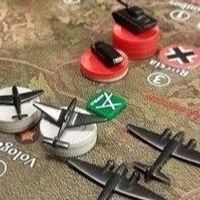


The rules are a bit confusing. Di the river crossing penalties only apply to attackers when they are Assaulting in their first attack? Or does it also apply equally to the defenders when they attack when the status changes to Battle in the same territory?
Possible Rule Modification for Balance
-
I’ve played a couple of games of A&A Stalingrad and found it to be a stimulating and changing game. However, agree with the sentiment that the Axis player must execute with near perfection AND enjoy favorable die rolls.
Was thinking about how to balance the game without compromising the vision of the designer. Landed on the penalty that the Russians suffer in the first two rounds. In addition to “Not stepping back”, Russian units must attack as if unsupplied during the first two rounds. Note that the penalty would not apply during the German turn (Russians on defense) but only on the Russian turn when their counterattacks might be stymied by draconian orders from above.
I suspect that, on average, about 15 to 20 counterattacking Russian units would be so penalized during these first two turns. That might leave the Axis player with 3 more units to engage in the City by turn 3.
Also interested to know if there is a 2nd edition to the rules coming.
-
@elque I actually think this is one of the more sane recommendations I’ve read that actually appreciates how delicate the balance in the game is (as in, the presence of just 1-2 more German units in the starting position, or good dice swings during the first 1-2 turns can easily turn the game into a one-sided stomp for Germany if they play properly).
That being said, I strongly believe that the optional rules on Pg. 28 are all important for helping to tune the game based on players’ familiarity levels (as Germany is the much more difficult/counterintuitive side to play by a ridiculous margin). Sadly, these rules have unfortunately gone overlooked by basically everyone I’ve seen comment on the game beyond a surface level. Specifically, I’m talking about:
-
Bidding - Which functions identically to bidding for league/convention play and is baked into the game rules. It’s literally the easiest way for players who can’t win with Germany to get to a more comfortable starting position.
-
Alternate Factory Placement - Which lets each side select where one of the factories go. This will make taking down one of the factories more difficult, but Germany being able to force a factory into a position where it is very easily occupied/disabled goes a long way towards neutering USSR’s ability to defend the city properly (although IMO it’s too strong for Germany).
-
Race to Stalingrad Alternative Deployment - Which on-paper lets both sides fine-tune their initial deployments. However, this helps Germany much more than it helps the USSR as USSR can only rearrange their position within the city, which isn’t as helpful as Germany being able to rearrange their entire position and do it in direct response to whatever USSR did.
-
Playing without all the optional rules cards, since almost all of these benefit the USSR exclusively and the ones that don’t are either not very helpful for Germany (Luftwaffe priorities) or benefit the USSR much more than the Germans (intercepts and interdiction).
-
-
@DoManMacgee Thanks for your comments. Agree that the optional rules can be used judiciously to balance the game. Specifically, I think that the alternative deployment option can be effective for the Axis player. Haven’t tried that yet.
While my experience is limited, my friend and I have played with the “Bad Weather Sorties” optional rule allowing air units to fight during bad weather. This seems to benefit the Axis player as that side almost always has more air units in play.
Related note - I’ve thought about the strategy of bombing Volga river crossings. It is typically a risky strategy for German air to fly into the city board given the prevalence of Russian artillery. It seems that 3 conditions must exist to make a raid profitable.
-
The Volga should be unfrozen necessitating the Russian player to replace the ferry if it is destroyed. More importantly, the loss of the ferry crossing must put Russian units in the corresponding city zone out of supply if and when it is destroyed
-
The Axis player should be actively engaging several Russian units whose combat effectiveness will be reduced by the elimination of the ferry.
-
There should be a Russian unit on the ferry that will be eliminated in the event of a successful raid
In short, if the axis player risks sending air to bomb a ferry crossing, it should be coordinated with major attacks in the corresponding city zone that will benefit from Russian units being put out of supply.
-
-
@elque Of the above about supply bombing, I mostly agree, although there are some caveats I would also at least consider that:
-
Point #2 could in some scenarios take priority over #3 to the point where #3 can be ignored (Ex. You’re fighting in one of the fortified zones and there is a big concentration of USSR dudes there, you’re fighting on top of one of the factories and taking the factory would block the USSR from getting a free piece on their half of the turn).
-
You can add a hypothetical Point #4 where you consider whether you air are better spent elsewhere.
One specific strategy in my own games (although for full disclosure I was on the playtest team so I have a lot more games logged than would be considered “normal”) is to launch a big attack against one of the major Soviet concentration points (i.e. Pittomnik, Spartanovka, the factories, etc.), throw in the entire German air force, and then purposely take the German air units as casualties. This seems strange from a normal A&A point of view (since air units are worth more IPC and have more ATK/DEF), but when you factor in that Germany has limited ability (no ability at the critical phase of the game) to buy new units + the fact that they need land units to take territory/lower USSR’s income/disable the factories + the looming threat of bad weather disabling (or limiting when playing with the optional rule) air units, I find the air units to actually have less value than you would expect on the surface.
To your point about Bad Weather Sorties, in the early phase of the game it does benefit the Germans overwhelmingly but if the game lasts long enough for Uranus to come into play, the Soviet Air Force will vastly outnumber the German one, and bad weather is one of the only things that can even hope to slow down the Soviet counterattack before it massacres the Germans.
(NOTE: The above blurb is assuming the Soviets are holding back Uranus until round 7, which is the general and most obvious plan. Part of what we hoped the metagame would be was that Germany would pressure USSR enough to force them to pop Uranus on turn 5/6 to avoid total defeat, which would in turn give Germany a fighting chance to make it to the end of the time limit instead of being forced to pursue total victory. Sadly, the steep requirements on the German player for playing the opening incredibly deliberately seems to have been way too much for normal kitchen table players to overcome, whereas the idea of just having USSR sit back until turn 7 then cruise to an easy win is very easy to grasp).
-
-
@DoManMacgee I think you are right to assign additional value to a ferry attack if German units are engaged with a cluster of Russians in a high value zone such as a factory or a key fortress. Putting russians out of supply via ferry bombing may be a superior option to simply adding those air units to the attack. Reducing the value of the russian counterattack can save german land units. More land units could mean holding onto valuable city territories for longer.
Not sure what the indifference point is but … my guess is that if three engaged russian units can be put out of supply in a city zone, it’s probably worth it. Maybe two units could be the minimum to warrant a ferry bombing if the engaged zone was strategic as you indicate. Note - a russian counter could be to drop a supply token in one of the factory zones. That would limit the utility of that first ferry bombing in the north.
Wow! an all out air assault on a fortified position. Yeah, I could see sending in the Axis air force as a can opener in Spartanovka . Follow up with Tank/Mech attack on the tank factory next turn?
-
@elque said in Possible Rule Modification for Balance:
Yeah, I could see sending in the Axis air force as a can opener in Spartanovka . Follow up with Tank/Mech attack on the tank factory next turn?
Pretty much. Because of how much value the factories generate (4 IPC for the ART, 6 IPC for the TANK, so ~5 IPC every turn when you average it) + the fact that it’s the only way for Soviets to get actually strong combat units into the city in the critical early phase of the game, Germany’s top priority should be disabling or at least challenging them. In my experience the games where Germany wins (or at least makes it close) are the ones where they get on top of the factories quickly.
@elque said in Possible Rule Modification for Balance:
I think you are right to assign additional value to a ferry attack if German units are engaged with a cluster of Russians in a high value zone such as a factory or a key fortress. Putting russians out of supply via ferry bombing may be a superior option to simply adding those air units to the attack. Reducing the value of the russian counterattack can save german land units. More land units could mean holding onto valuable city territories for longer.
Not sure what the indifference point is but … my guess is that if three engaged russian units can be put out of supply in a city zone, it’s probably worth it. Maybe two units could be the minimum to warrant a ferry bombing if the engaged zone was strategic as you indicate. Note - a russian counter could be to drop a supply token in one of the factory zones. That would limit the utility of that first ferry bombing in the north.
IMO it mostly comes down to your own gut + checking how much air you actually need to commit to the fight to (in your estimation, anyway) clear the territory in 1 “turn” (so the German attack + the USSR’s forced counterattack during their half of the round). Unlike 1914 (the WW1 A&A game), you’re not allowed to refuse combat in Stalingrad, so if you commit your forces the right way you can make sure to (in most cases) have a territory cleared out before the start of Germany’s next turn, meaning you’re always moving forward. I would say that the ability to keep your guys moving is almost as important as conserving HP (muddying the waters on the debate over how many air to send to the ferries Vs. how many to send to your big fights). Getting bogged down even for 1 extra turn is usually a bad sign given how tight the timeline is before Uranus appears (after which Germany only really has about 2 turns before getting their supply cut).
As a side-tangent: The strict requirements on things going well for Germany (as in, Germany never rolls severely under (which prolongs fights) and USSR never gets a lucky break (and kills too many Germans)) basically everywhere is probably part of why games feel so lopsided to the average joe who isn’t playing optimally (since any positioning errors is going to throw off your timetable even more). IDK if I’m technically “allowed” to say this (and if I get an earful over it I’ll just delete it I guess), but a good chunk of the later part of testing was actually spent trying to stop Germany from basically winning every time, so that’s probably why it feels difficult for them to win in the hands of players who don’t have like 20+ games logged against similarly skilled opponents.
Suggested Topics