Axis & Allies .org Forums
    • Home
    • Categories
    • Recent
    • Popular
    • Users
    • Register
    • Login
    1. Home
    2. Charles de Gaulle
    • Profile
    • Following 0
    • Followers 7
    • Topics 34
    • Posts 496
    • Best 41
    • Controversial 0
    • Groups 0

    Charles de Gaulle

    @Charles de Gaulle

    52
    Reputation
    620
    Profile views
    496
    Posts
    7
    Followers
    0
    Following
    Joined Last Online
    Age 26

    Charles de Gaulle Unfollow Follow

    Best posts made by Charles de Gaulle

    • [G1940] Cooperative Nation Control

      Recently, I took part in an eighteen player game of Global 1940 with no drastic house rules aside from this: most nations were controlled by more than one player.  Each major nation was assigned a top leader, which we named according to the title of the real leader of the nation.  Under this leader were two generals, each one focusing on a certain front.  The generals selected their desired purchases for their section but had to get approval from the top leader.  Troops movements, attacks, and cooperation worked likewise.  This system not only resulted in more people playing, but it also eliminated mistakes greatly, encouraged teamwork, and bred a healthy rivalry between generals working for the same nation.  Here is how we played originally (we did have to reorganize command as the war eliminated forces or shifted focus).

      Germany:
      The top leader was called the Fuhrer, mostly because he liked roleplaying as a bad guy.  The two generals under him were split between the obvious: Eastern and Western Front.  These three players worked together beautifully.  The Eastern and Western troops were always ready to sacrifice for the good of the other half, and the top leader made sure his generals never made a single mistake.

      Soviet Union:
      The Soviets chose the title Premier for their top leader.  The two generals were split on very awkward lines: one player controlled the north (Leningrad area and the Far East) and the other controlled the southern half (Moscow to the Caucasus). The Premier was a bit too oppressive over his two generals and usually tended to make their decisions for them.  This was funny at first to the other nations, but resulted in a boring, bitter game for the two Russian general players.  The lack of unity between the two Russian players and the oppressive nature of their leader resulted in the Soviets’ collapse.

      Japan:
      The Japanese players chose not to have a title for their top leader and took the game very seriously.  Instead of dividing themselves between fronts, they decided to have one national leader, one naval leader, and one army leader (airforces were attached to one or the other.)  Their teamwork was excellent and their top leader kept them from being reckless, but in the end, Japan was basically a defensive force that was too huddled in its corner of the world.  I would say Japan was a success for the coop system but a failure strategically.

      United States:
      I played on the U.S. team as General Eisenhower controlling the Americans in the European theater (I Like roleplaying, so deal with it.)  My counterpart, of course, controlled the Pacific.  Much to his dismay, I always called him “the Nimitz with no trannies [transports].”  We also had a top leader over us representing the President.  Although our actions could not save the world from the Axis, I felt that the U.S. team did a great job of showing how coop play could work.  There was a great rivalry between me and my Pacific teammate as we always tried to convince the “Pres.” to let one of us get more IPCs to spend on our side.  Our top leader did a good job of being neutral and sharing wisdom while allowing us to go with what we thought was best.

      China and France were played by one person.  With eighteen people at the table one time or another and players arguing over who is going to get a single fighter for use at their front, China and France felt like a big role for a change.

      United Kingdom:
      The UK chose the title Prime Minister for their top leader. The two generals under him were constantly getting their zones of control reorganized, but they started with one controlling Malta to India, and the other getting Gibraltar to Iceland.  The UK had the opposite problem of Russia.  Their leader was too weak and only ended up compromising disputes.  Perhaps the main reason for this was that India gets its own economy and is virtually separate from the rest of the UK’s responsibilities.

      Italy and ANZAC were played by two different players.  Like the person playing China and France, the Italian and ANZAC players were satisfied with the small roles because everbody around the table also had small roles.

      Overall, I loved this system.  It encouraged teamwork greatly, added a nice feel of reality, eliminated many stupid mistakes, and made the whole A&A experience much more social.  Of course, having so many people did make it crowded at times, but at no one time were there eighteen people seated at the table.  In between turns, only one person stayed to represent their nation while the others left to plan, eat snacks, or take some shots on the pool table on the other side of the room.

      I had a fantastic experience playing like this, and I wonder if any of you have ever tried this before.  Sometimes even just having two people work together for a nation (without splitting up zones of control) can be very fun.  If you do ever try this regional generals system, I highly recommend that you have a top leader as well.  He is the one that makes a split army capable of working together to achieve victory.

      posted in House Rules
      Charles de GaulleC
      Charles de Gaulle
    • World War 2 Axis and Allies on the 1914 Board?

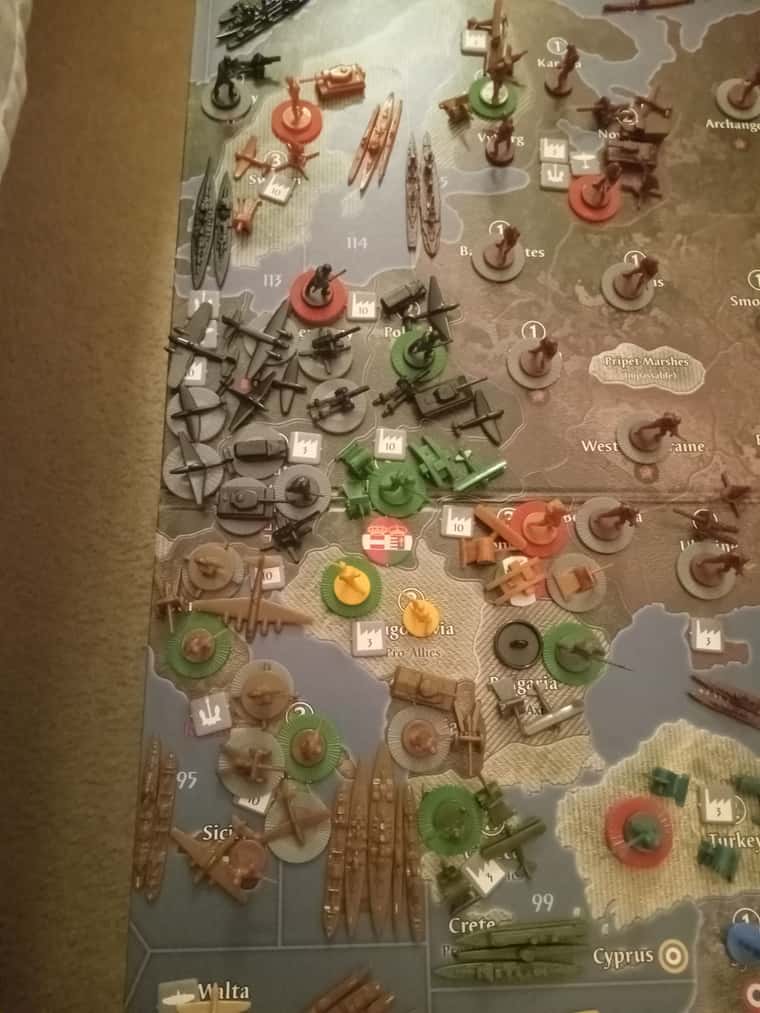
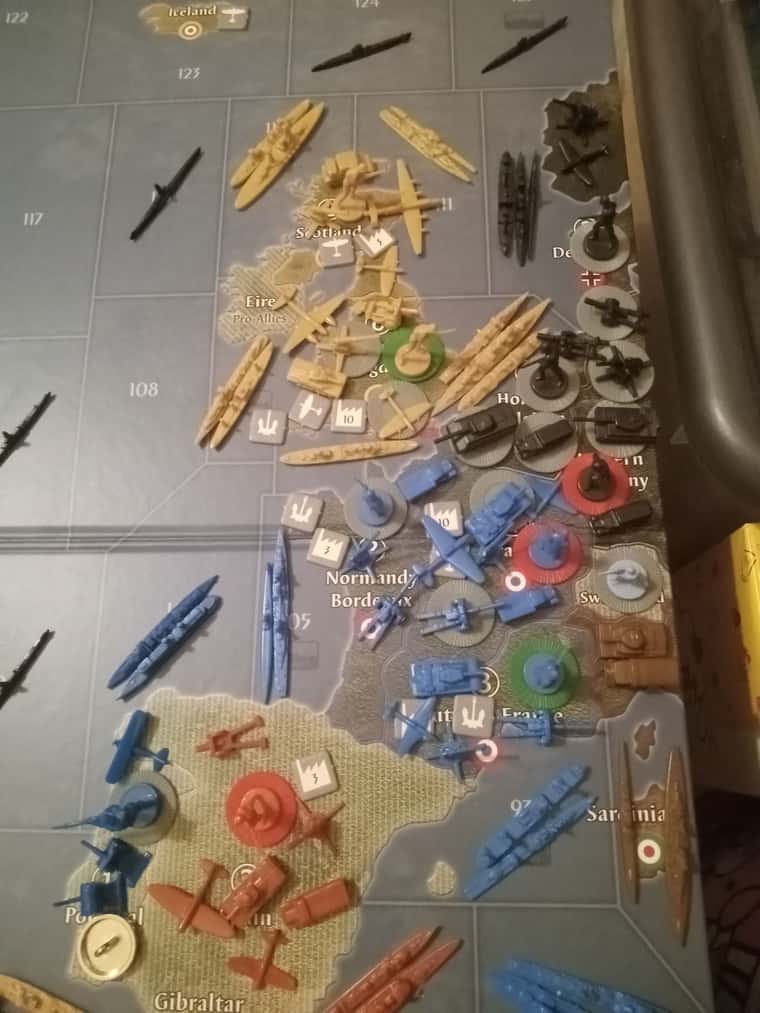
      When you’re stuck at home in quarantine and you have nothing that you need to do, sometimes the craziest ideas will cross your mind:IMG_20200508_173034_hdr.jpgIMG_20200508_173932_hdr.jpg IMG_20200508_173959_hdr.jpg IMG_20200508_174031_hdr.jpg IMG_20200508_174049_burst_01.jpg IMG_20200508_174015_hdr.jpg
      This is something I’ve actually been toying with for a while: a 1939 or 1937 game played on the 1914 board. It’s been a great deal of fun, but I usually find myself exploring alternate history rather than creating a game that is actually balanced with streamlined rules.

      Have you ever experimented with playing a World War 2 era game on 1914 with the rules and units from 1940? Making a good setup has been difficult, and some places like Russia just aren’t ideal, but I’ve seen a lot of potential with making an early war scenario like this with many playable little nations. OH, and a well-defended France as well. ;)

      Have I just gone crazy, or is this an interesting idea?

      posted in House Rules
      Charles de GaulleC
      Charles de Gaulle
    • RE: World War 2 Axis and Allies on the 1914 Board?

      IMG_20200508_195523_hdr.jpg
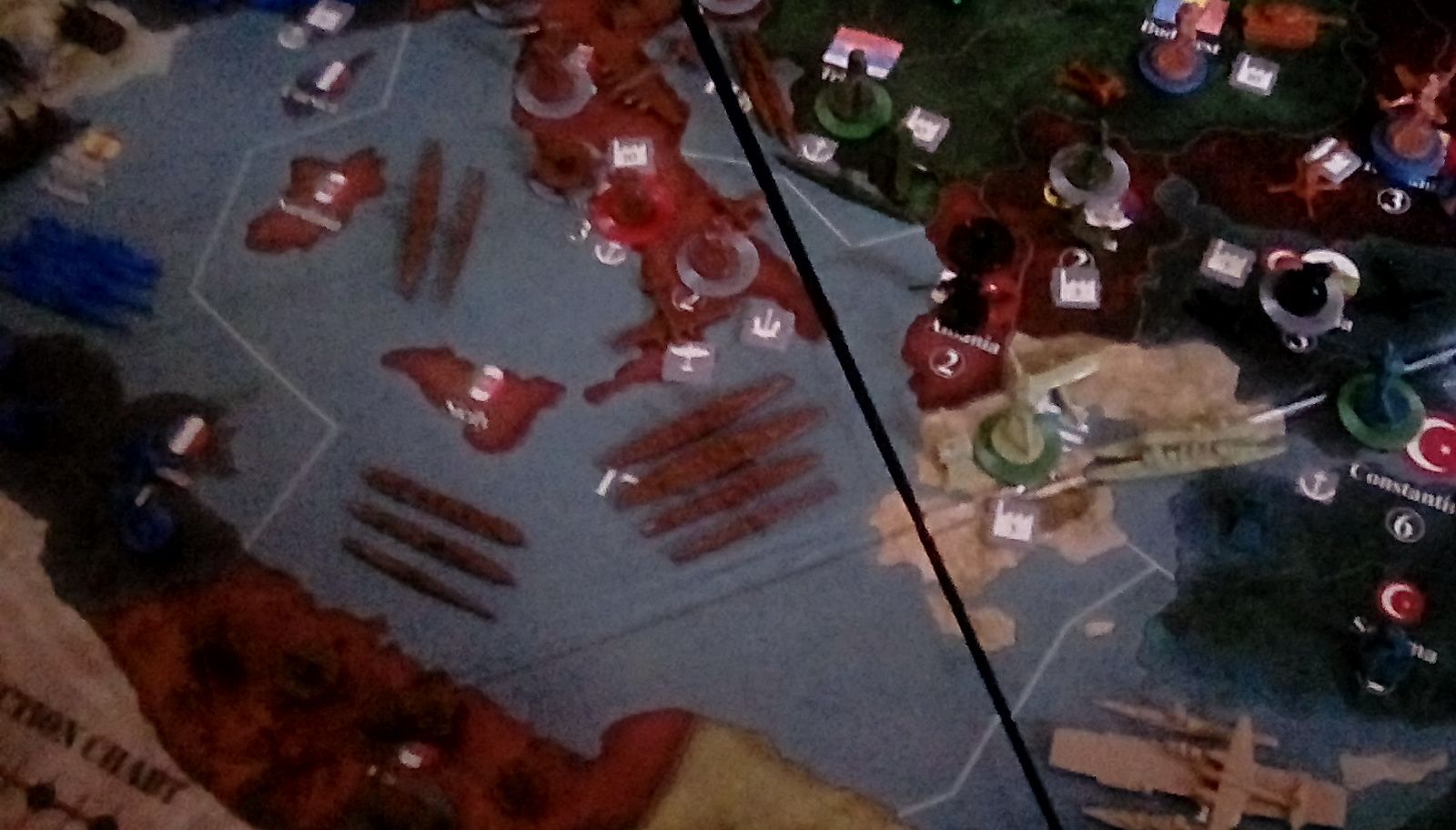
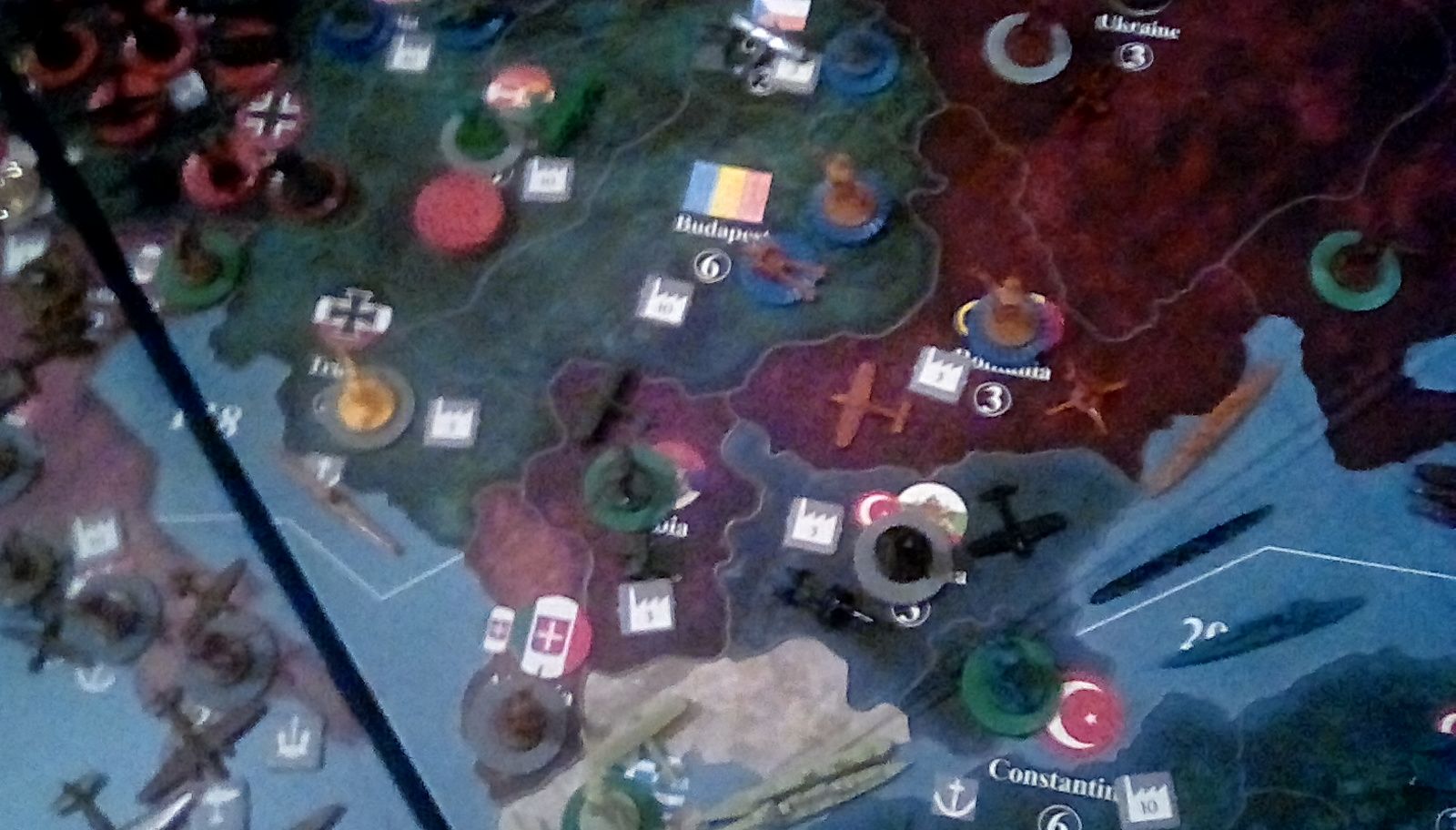
      Chaos in the Balkans:
      Hungary and Romania are at war, Germany has annexed Austria, Yugoslavia suffered an unfortunate die role and has been forced to disintegrate into a Pro-Fascist Croatian state and a smaller Serbia. Italy managed to seize Albania without loss, and Czechoslovakia is reinforcing its border with the Nazis.
      The UK has pledged to declare war on any power invading Greece.
      IMG_20200508_200336_hdr.jpg
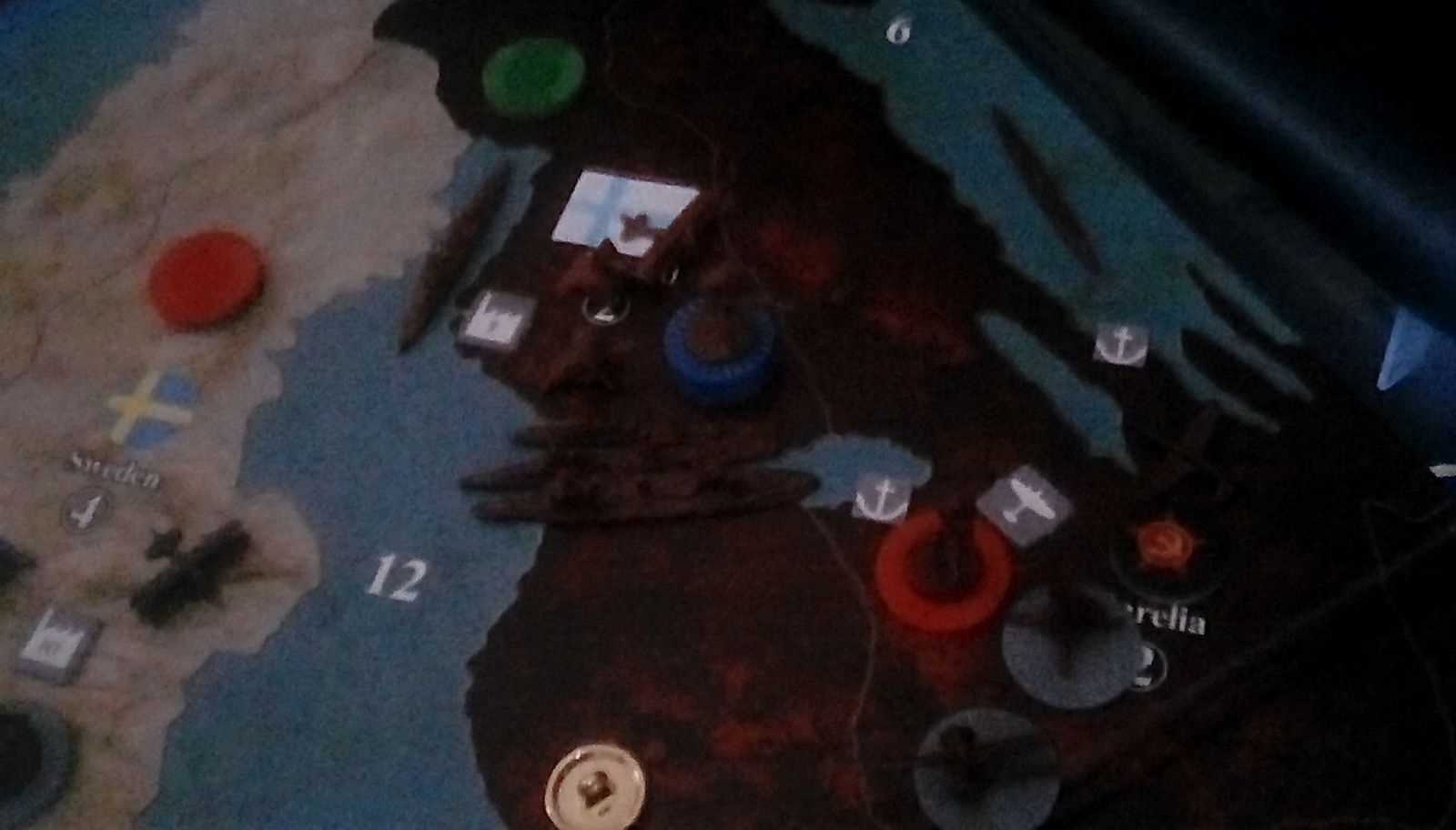
      Swedish Disaster:
      The Swedes attempted to peacefully take over Norway to prevent any major nations from entering Scandinavia, but the plan backfired. Not only did another unfortunate die role cause the Norwegians to resist, but the German and British players were offended by the assault, and Germany turned a blind eye to a British force that liberated the Norwegians and devastated Sweden’s hopes of a powerful, neutral, United Scandinavian state.
      IMG_20200508_200349_hdr.jpg
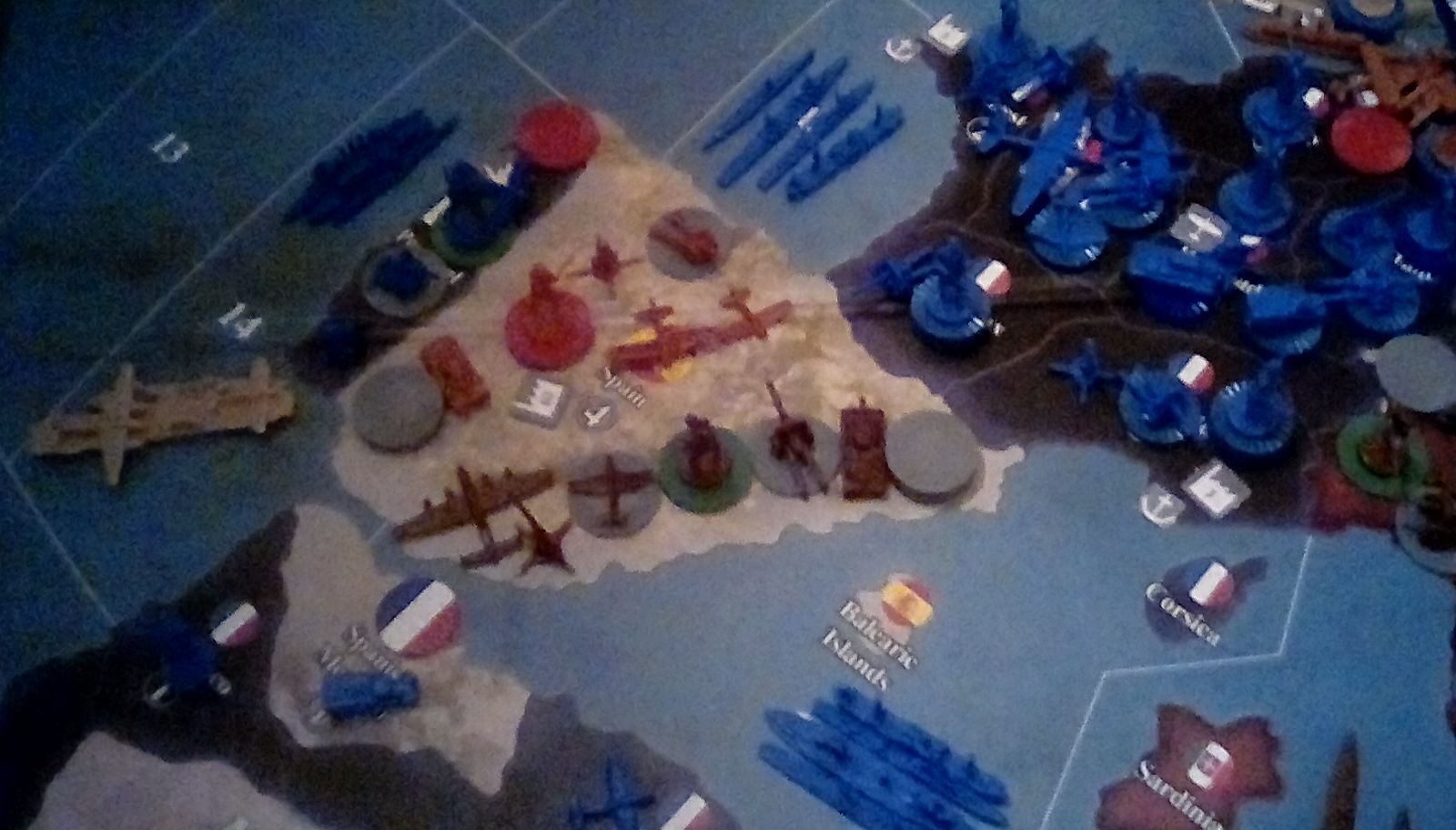
      Spain in Flames:
      The civil war rages on in Spain, just as a deadly naval encounter ended in mutual annihilation for the Nationalists and Republicans. The free world does not want a Fascist Spain, and the U.S. Player has sent generous air aid to the Republicans. With Franco’s Army of Africa having headed for the mainland, I, as France, took advantage and seized their Moroccan colony. Unfortunately, I earned a -1 diplomacy points for this “aggressive” act.

      posted in House Rules
      Charles de GaulleC
      Charles de Gaulle
    • Global/Europe/Pacific 1939 for 1940 2nd Editon

      Global 1939 Version 3 plus tweaks (Europe and Pacific Standalone setups are further below)

      Axis and Allies Global 1939 is a 1940 variant that uses a new setup and political situation.

      Global (Europe + Pacific):
      Anything not specified here is the same as 1940 2nd Edition.

      Political situation changes:

      Russia may not declare war on Germany/Italy until turn 5 unless attacked by the Axis.

      Nazi-Soviet Pact:
      On turn 1 only, Russia is given the option of attacking/annexing any of these territories: Vyborg, Baltic States, Eastern Poland, and Bessarabia.  Germany may not take any of the aforementioned territories or trigger Finalnd on turn 1 without declaring war on Russia.  If Russia does not take some/all of these territories, Germany may take them without consequence starting on turn 2.  Vyborg is hostile to Russia and friendly to Germany.  Eastern Poland is an enemy to both Russia and Germany.

      Germany is allowed to move through the Danish straits even though Germany does not control Denmark on turn 1.

      Italy begins the game neutral and cannot leave its territories.  Other powers cannot enter neutral Italy.  Italy may declare on any Allied powers on turn 2 or later.  If Italy stays neutral, the Allies may declare war on Italy on turn 3 or later.  On the turn Italy declares war or the Allies attack Italy, transports may load units in shared sea zones shared between Italy and the Allies.

      The United States may declare war on the Axis on the collect income phase of turn 4.
      The minor industrial complexes on Western, Eastern, and Central U.S. don’t get upgraded automatically.  The U.S. must pay for the upgrades if it wants them.

      The new pro-Allies/-Axis (same rules as for Persia, Iraq, etc.) and their standing armies are
      Pro-Allies:
      Poland: 6 infantry
      Eastern Poland: 2 infantry
      Denmark: 1 infantry
      Norway: 2 infantry
      Holland/Belgium: 3 infantry
      Iceland: nothing
      Greenland: nothing
      Belgian Congo: 1 infantry
      Pro-Axis:
      Slovakia/Hungary: 3 infantry, 3 tanks
      Romania: 4 infantry, 1 artillery, 1 fighter
      Bessarabia: nothing
      Baltic States: nothing
      Vyborg: 2 infantry
      Northwest Persia: nothing
      Persia: 2 infantry
      Eastern Persia: nothing

      When collecting NOs, treat the territories as the board represents them (e.g. the original controller).
      Examples:
      Iceland and Belgian Congo do not start as British anymore, but they are needed for UK’s NO for holding the empire because they have a British roundel on them.
      Even though Persia is pro-Axis in this setup, it does not count in Russia’s spread of Communism NO because the board represents it as being pro-Allies.

      New Turn order and starting income/IPCs in hand:
      Germany: 14
      Soviet Union: 35
      United Kingdom-
      Europe: 27
      Pacific: 17
      Italy: 10
      France: 19
      ANZAC: 10
      Japan: 24
      China: 14
      United States: 52

      New Setup:
      Germany:
      Germany: 16 infantry, 4 artillery, 1 tactical bomber, 4 AA guns, 2 strategic bombers, major industrial complex
      Greater Southern Germany: 6 infantry, 2 artillery, 3 tanks
      Western Germany: 2 infantry, 3 tanks, 4 AA guns, 4 fighters, 3 tactical bombers, 2 mech., air base, naval base, major industrial complex
      Sea Zone 112: 2 submarines, 1 destroyer
      Sea Zone 113: 2 submarines, 1 transport, 1 cruiser
      Sea Zone 114: 1 submarine, 1 transport, 1 battleship

      Soviet Union:
      Russia: 1 infantry, 1 AA gun, 1 artillery, 1 strategic bomber, air base, minor industrial complex
      Samara: 1 infantry
      Novosibirsk: 1 infantry
      Kazakhstan: 1 infantry
      Turkmenistan: 1 infantry
      Caucasus: 1 infantry, 1 artillery
      Volgograd: 1 infantry, 1 AA gun, minor industrial complex
      Ukraine: 2 infantry, 1 tactical bomber
      Western Ukraine: 2 infantry, 1 artillery
      Belarus: 2 infantry, 1 mechanized infantry
      Novgorod: 6 infantry, 1 artillery, 2 AA guns, 1 tank, 1 fighter, air base, naval base, minor industrial complex
      Karelia: 2 infantry
      Timguska: 1 infantry
      Yenisey: 1 infantry
      Yakut: 1 infantry
      Buryatia: 2 infantry
      Sakha: 2 infantry
      Amur: 4 infantry, 1 artillery, 1 mechanized infantry, 2 AA guns, 1 tank
      Siberia: 1 infantry
      Soviet Far East: 1 infantry
      Sea Zone 100: 1 destroyer, 1 cruiser
      Sea Zone 115: 1 destroyer, 1 battleship
      Sea Zone 127: 1 submarine

      Italy:
      Southern Italy: 4 infantry, 2 artillery, 2 AA guns, 1 fighter, air base, naval base, major industrial complex
      Northern Italy: 4 infantry, 1 mechanized infantry, 1 tank, 1 strategic bomber, 1 tactical bomber, minor industrial complex
      Sardinia: 1 infantry
      Sicily: 1 infantry
      Albania: 1 infantry, 1 artillery, 1 tank
      Libya: 3 infantry, 1 artillery, 1 mechanized infantry, 1 tank
      Tobruk: 2 infantry, 1 artillery, 1 mechanized infantry
      Ethiopia: 2 infantry, 1 artillery, 1 tank
      Italian Somaliland: 1 infantry, 1 mechanized infantry
      Sea Zone 95: 1 submarine, 1 destroyer, 1 transport, 1 cruiser
      Sea Zone 97: 1 destroyer, 1 cruiser, 1 battleship, 1 transport

      France:
      France: 6 infantry, 3 AA guns, 3 artillery, 2 tanks, 2 fighters, air base, minor industrial complex
      Normandy/Bordeaux: 1 infantry, naval base, minor industrial complex
      Southern France: 1 infantry, 1 artillery, naval base
      Tunisia: 1 infantry, 1 artillery
      Algeria: 1 infantry, 1 mech.
      Morocco: 1 infantry, 1 AA gun
      French West Africa: 1 infantry
      French Central Africa: 1 infantry
      Syria: 1 infantry
      Sea Zone 105: 1 destroyer, 1 transport
      Sea Zone 93: 1 cruiser, 1 transport
      Sea Zone 94: 1 battleship
      Sea Zone 82: 1 submarine
      Sea Zone 72: 1 destroyer

      Japan:
      Japan: 6 infantry, 1 mech., 2 artillery, 2 AA guns, 1 tank, 2 fighters, 2 tactical bombers, 2 strategic bombers, air base, naval base, major IC
      Korea: 2 infantry, 1 mechanized infantry
      Manchuria: 6 infantry, 1 mech., 1 artillery, 1 tank, 2 fighters, 2 tactical bombers, 1 AA gun, control marker
      Jehol: 3 infantry, 1 artillery, control marker
      Shantung: 3 infantry, 1 artillery, control marker
      Kiangsu: 5 infantry, 2 artillery, control marker
      Okinawa: 1 infantry, 1 fighter
      Formosa: 1 infantry, 1 fighter
      Hainan: 1 infantry
      Palau: 1 infantry
      Caroline Islands: 1 infantry, 1 AA gun, air base, naval base
      Marshall Islands: 1 infantry, air base, 1 fighter, 1 tactical bomber
      Marianas: 1 infantry, naval base, 1 AA gun
      Iwo Jima: 1 infantry, 1 AA gun
      Siam 2 infantry
      Sea Zone 6: 1 submarine, 3 transports, 1 destroyer, 1 cruiser, 1 battleship, 2 carriers with 2 fighters and 2 tactical bombers
      Sea Zone 19: 1 transport, 1 cruiser, 1 destroyer
      Sea Zone 20: 1 destroyer, 1 submarine, 1 aircraft carrier with 1 fighter and 1 tactical bomber
      Sea Zone 36: 1 destroyer
      Sea Zone 22: 1 cruiser
      Sea Zone 33: 1 battleship, 1 destroyer, 1 submarine
      Sea Zone 32: 1 destroyer

      United States:
      Western United States: 1 infantry, 1 artillery, 1 AA gun, 1 fighter, air base, naval base, minor IC
      Alaska: 1 infantry
      Hawaii: 1 infantry, 1 AA gun, 1 fighter, 1 strategic bomber air base, naval base
      Midway: air base
      Wake: air base
      Guam: air base
      Philippines: 2 infantry, 1 fighter, air base, naval base
      Eastern United States: 1 infantry, 1 artillery, 1 AA gun, 1 fighter, air base, naval base, minor industrial complex
      Central United States: 1 mechanized infantry, 1 tank, minor industrial complex
      Sea Zone 64: 1 cruiser
      Sea Zone 101: 1 destroyer
      Sa Zone 10: 1 submarine, 1 transport, 1 destroyer, 1 cruiser, 1 battleship
      Sea Zone 29: 1 carrier with 1 fighter and 1 tactical bomber
      Sea Zone 26: 1 submarine, 1 destroyer, 1 cruiser
      Sea Zone 35: 1 destroyer

      China:
      Suiyuan: 3 infantry
      Chahar: 1 infantry
      Anhwe: 3 infantry
      Kiangsi: 2 infantry
      Kwangsi: 2 infantry
      Hunan: 2 infantry
      Kweichow: 3 infantry, 1 artillery
      Hopei: 1 infantry
      Shensi: 1 infantry
      Szechwan: 4 infantry, 1 artillery, 1 fighter
      Yunnan: 3 infantry

      United Kingdom:
      United Kingdom: 2 infantry, 1 AA gun, 1 artillery, 1 tank, 1 fighter, 1 strategic bomber, air base, naval base, major industrial complex
      Scotland: 1 infantry, 1 AA gun, 1 fighter, air base
      Quebec: 1 infantry, 1 fighter, 1 mechanized infantry, minor industrial complex
      Nova Scotia: naval base, air base
      Ontario: 1 AA gun, 1 artillery, 1 tank
      Gibraltar: naval base
      Malta: 1 fighter, 1 infantry, 1 AA gun, airbase
      Alexandria: 1 infantry, 1 mechanized infantry, 1 tank
      Egypt: 1 infantry, 1 artillery, 1 AA gun, naval base
      Trans-Jordan: 1 infantry
      British Somaliland: 1 infantry
      Kenya: 1 infantry
      Rhodesia: 1 infantry
      Anglo-Egypt Sudan: 1 infantry
      Union of South Africa: 1 infantry, 1 tank, 1 mechanized infantry, naval base, minor industrial complex
      West India: 2 infantry, 1 artillery
      India: 4 infantry, 1 artillery, 2 AA guns, 1 fighter, 1 tactical bomber, air base, naval base, major industrial complex
      Burma: 2 infantry
      Shan State: 1 infantry
      Malaya: 3 infantry, naval base
      Kwangtung: 1 infantry, naval base
      Samoa: naval base
      Sea Zone 106: 1 transport, 1 destroyer
      Sea Zone 109: 1 transport, 1 cruiser
      Sea Zone 110: 1 destroyer, 1 battleship, 1 transport
      Sea Zone 111: 1 cruiser
      Sea Zone 91: 1 cruiser, 1 aircraft carrier (carrying 1 tactical bomber)
      Sea Zone 98: 1 destroyer, 1 submarine, 1 battleship
      Sea Zone 81: 1 cruiser
      Sea Zone 71: 1 destroyer
      Sea Zone 70: 1 transport
      Sea Zone 39: 1 cruiser, 1 sub
      Sea Zone 37: 1 destroyer, 1 battleship
      Sea Zone 51: 1 destroyer

      ANZAC:
      New South Wales: 1 infantry, 1 artillery, 1 tank, naval base, minor IC
      Queensland: 1 infantry, 1 AA gun, 1 fighter, air base
      Northern Territory: 1 infantry, 1 AA gun
      Western Australia: 1 infantry, 1 mechanized infantry
      New Zealand: 2 infantry, 1 AA gun,  1 fighter, naval base, minor IC
      Malaya: 1 infantry
      Shan State: 1 infantry
      Trans-Jordan: 1 infantry
      Egypt: 1 infantry
      Sea Zone 62: 1 cruiser
      Sea Zone 63: 1 destroyer
      Sea Zone 54: 1 cruiser, 1 destroyer
      –---------------------------

      Pacific 1939 Standalone:

      Anything not specified here is the same as 1940 2nd Edition.

      The United States may declare war on Japan on the collect income phase of turn 4.

      New Turn order and starting income/IPCs in hand:
      United Kingdom: 16
      ANZAC: 10
      Japan: 24
      China: 14
      United States: 17

      New Setup:
      Japan:
      Japan: 6 infantry, 1 mech., 2 artillery, 2 AA guns, 1 tank, 2 fighters, 2 tactical bombers, 2 strategic bombers, air base, naval base, major IC
      Korea: 2 infantry, 1 mechanized infantry
      Manchuria: 6 infantry, 1 mech., 1 artillery, 1 tank, 2 fighters, 2 tactical bombers, 1 AA gun, control marker
      Jehol: 3 infantry, 1 artillery, control marker
      Shantung: 3 infantry, 1 artillery, control marker
      Kiangsu: 5 infantry, 2 artillery, control marker
      Okinawa: 1 infantry, 1 fighter
      Formosa: 1 infantry, 1 fighter
      Hainan: 1 infantry
      Palau: 1 infantry
      Caroline Islands: 1 infantry, 1 AA gun, air base, naval base
      Marshall Islands: 1 infantry, air base, 1 fighter, 1 tactical bomber
      Marianas: 1 infantry, naval base, 1 AA gun
      Iwo Jima: 1 infantry, 1 AA gun
      Siam 2 infantry
      Sea Zone 6: 1 submarine, 3 transports, 1 destroyer, 1 cruiser, 1 battleship, 2 carriers with 2 fighters and 2 tactical bombers
      Sea Zone 19: 1 transport, 1 cruiser, 1 destroyer
      Sea Zone 20: 1 destroyer, 1 submarine, 1 aircraft carrier with 1 fighter and 1 tactical bomber
      Sea Zone 36: 1 destroyer
      Sea Zone 22: 1 cruiser
      Sea Zone 33: 1 battleship, 1 destroyer, 1 submarine
      Sea Zone 32: 1 destroyer

      United States:
      Western United States: 1 infantry, 1 artillery, 1 AA gun, 1 fighter, air base, naval base, major IC
      Alaska: 1 infantry
      Hawaii: 1 infantry, 1 AA gun, 1 fighter, 1 strategic bomber air base, naval base
      Midway: air base
      Wake: air base
      Guam: air base
      Philippines: 2 infantry, 1 fighter, air base, naval base
      Sa Zone 10: 1 submarine, 1 transport, 1 destroyer, 1 cruiser, 1 battleship
      Sea Zone 29: 1 carrier with 1 fighter and 1 tactical bomber
      Sea Zone 26: 1 submarine, 1 destroyer, 1 cruiser
      Sea Zone 35: 1 destroyer

      China:
      Suiyuan: 3 infantry
      Chahar: 1 infantry
      Anhwe: 3 infantry
      Kiangsi: 2 infantry
      Kwangsi: 2 infantry
      Hunan: 2 infantry
      Kweichow: 3 infantry, 1 artillery
      Hopei: 1 infantry
      Shensi: 1 infantry
      Szechwan: 4 infantry, 1 artillery, 1 fighter
      Yunnan: 3 infantry

      United Kingdom:
      India: 4 infantry, 1 artillery, 2 AA guns, 1 fighter, 1 tactical bomber, air base, naval base, major IC
      Burma: 2 infantry
      Shan State: 1 infantry
      Malaya: 3 infantry, naval base
      Kwangtung: 1 infantry, naval base
      Samoa: naval base
      Sea Zone 39: 1 cruiser, 1 sub
      Sea Zone 37: 1 destroyer, 1 battleship
      Sea Zone 51: 1 destroyer

      ANZAC:
      New South Wales: 1 infantry, 1 artillery, 1 tank, naval base, minor IC
      Queensland: 1 infantry, 1 AA gun, 1 fighter, air base
      Northern Territory: 1 infantry, 1 AA gun
      Western Australia: 1 infantry, 1 mechanized infantry
      New Zealand: 2 infantry, 1 AA gun,  1 fighter, naval base, minor IC
      Malaya: 1 infantry
      Shan State: 1 infantry
      Sea Zone 62: 1 cruiser
      Sea Zone 63: 1 destroyer
      Sea Zone 54: 1 cruiser, 1 destroyer

      Europe Standalone:
      Anything not specified here is the same as 1940 2nd Edition.

      Political situation changes:

      Russia may not declare war on Germany/Italy until turn 5 unless attacked by the Axis.

      Nazi-Soviet Pact:
      On turn 1 only, Russia is given the option of attacking/annexing any of these territories: Vyborg, Baltic States, Eastern Poland, and Bessarabia.  Germany may not take any of the aforementioned territories or trigger Finalnd on turn 1 without declaring war on Russia.  If Russia does not take some/all of these territories, Germany may take them without consequence starting on turn 2.  Vyborg is hostile to Russia and friendly to Germany.  Eastern Poland is an enemy to both Russia and Germany.

      Germany is allowed to move through the Danish straits even though Germany does not control Denmark on turn 1.

      Italy begins the game neutral and cannot leave its territories.  Other powers cannot enter neutral Italy. Italy may declare on any Allied powers on turn 2 or later.  If Italy stays neutral, the Allies may declare war on Italy on turn 3 or later.  On the turn Italy declares war or the Allies attack Italy, transports may load units in shared sea zones shared between Italy and the Allies.

      The United States may declare war on the Axis on the collect income phase of turn 4.
      The minor industrial complexes on Eastern and Central U.S. don’t get upgraded automatically.  The U.S. must pay for the upgrades if it wants them.

      The new pro-Allies/-Axis (same rules as for Persia, Iraq, etc.) and their standing armies are
      Pro-Allies:
      Poland: 6 infantry
      Eastern Poland: 2 infantry
      Denmark: 1 infantry
      Norway: 2 infantry
      Holland/Belgium: 3 infantry
      Iceland: nothing
      Greenland: nothing
      Belgian Congo: 1 infantry
      Pro-Axis:
      Slovakia/Hungary: 3 infantry, 3 tanks
      Romania: 4 infantry, 1 artillery, 1 fighter
      Bessarabia: nothing
      Baltic States: nothing
      Vyborg: 2 infantry
      Northwest Persia: nothing
      Persia: 2 infantry
      Eastern Persia: nothing

      When collecting NOs, treat the territories as the board represents them (e.g. the original controller).
      Examples:
      Iceland and Belgian Congo do not start as British anymore, but they are needed for UK’s NO for holding the empire because they have a British roundel on them.
      Even though Persia is pro-Axis in this setup, it does not count in Russia’s spread of Communism NO because the board represents it as being pro-Allies.

      New Turn order and starting income/IPCs in hand:
      Germany: 14
      Soviet Union: 26
      United Kingdom: 28
      Italy: 10
      France: 17
      United States: 35

      New Setup:
      Germany:
      Germany: 16 infantry, 4 artillery, 1 tactical bomber, 4 AA guns, 2 strategic bombers, major industrial complex
      Greater Southern Germany: 6 infantry, 2 artillery, 3 tanks
      Western Germany: 2 infantry, 3 tanks, 4 AA guns, 4 fighters, 3 tactical bombers, 2 mech., air base, naval base, major industrial complex
      Sea Zone 112: 2 submarines, 1 destroyer
      Sea Zone 113: 2 submarines, 1 transport, 1 cruiser
      Sea Zone 114: 1 submarine, 1 transport, 1 battleship

      Soviet Union:
      Russia: 1 infantry, 1 AA gun, 1 artillery, 1 strategic bomber, air base, minor industrial complex
      Samara: 1 infantry
      Novosibirsk: 1 infantry
      Kazakhstan: 1 infantry
      Turkmenistan: 1 infantry
      Caucasus: 1 infantry, 1 artillery
      Volgograd: 1 infantry, 1 AA gun, minor industrial complex
      Ukraine: 2 infantry, 1 tactical bomber
      Western Ukraine: 2 infantry, 1 artillery
      Belarus: 2 infantry, 1 mechanized infantry
      Novgorod: 6 infantry, 1 artillery, 2 AA guns, 1 tank, 1 fighter, air base, naval base, minor industrial complex
      Karelia: 2 infantry
      Sea Zone 100: 1 destroyer, 1 cruiser
      Sea Zone 115: 1 destroyer, 1 battleship
      Sea Zone 127: 1 submarine

      Italy:
      Southern Italy: 4 infantry, 2 artillery, 2 AA guns, 1 fighter, air base, naval base, major industrial complex
      Northern Italy: 4 infantry, 1 mechanized infantry, 1 tank, 1 strategic bomber, 1 tactical bomber, minor industrial complex
      Sardinia: 1 infantry
      Sicily: 1 infantry
      Albania: 1 infantry, 1 artillery, 1 tank
      Libya: 3 infantry, 1 artillery, 1 mechanized infantry, 1 tank
      Tobruk: 2 infantry, 1 artillery, 1 mechanized infantry
      Ethiopia: 2 infantry, 1 artillery, 1 tank
      Italian Somaliland: 1 infantry, 1 mechanized infantry
      Sea Zone 95: 1 submarine, 1 destroyer, 1 transport, 1 cruiser
      Sea Zone 97: 1 destroyer, 1 cruiser, 1 battleship, 1 transport

      France:
      France: 6 infantry, 3 AA guns, 3 artillery, 2 tanks, 2 fighters, air base, minor industrial complex
      Normandy/Bordeaux: 1 infantry naval base, minor industrial complex
      Southern France: 1 infantry, 1 artillery, naval base
      Tunisia: 1 infantry, 1 artillery
      Algeria: 1 infantry, 1 mech.
      Morocco: 1 infantry, 1 AA gun
      French West Africa: 1 infantry
      French Central Africa: 1 infantry
      Syria: 1 infantry
      Sea Zone 105: 1 destroyer, 1 transport
      Sea Zone 93: 1 cruiser, 1 transport
      Sea Zone 94: 1 battleship
      Sea Zone 82: 1 submarine
      Sea Zone 72: 1 destroyer

      United States:
      Eastern United States: 1 infantry, 1 artillery, 1 AA gun, 1 fighter, air base, naval base, minor industrial complex
      Central United States: 1 mechanized infantry, 1 tank, minor industrial complex
      Sea Zone 64: 1 cruiser
      Sea Zone 101: 1 destroyer

      United Kingdom:
      United Kingdom: 2 infantry, 1 AA gun, 1 artillery, 1 tank, 1 fighter, 1 strategic bomber, air base, naval base, major industrial complex
      Scotland: 1 infantry, 1 AA gun, 1 fighter, air base
      Quebec: 1 infantry, 1 fighter, 1 mechanized infantry, minor industrial complex
      Nova Scotia: naval base, air base
      Ontario: 1 AA gun, 1 artillery, 1 tank
      Gibraltar: naval base
      Malta: 1 fighter, 1 infantry, 1 AA gun, airbase
      Alexandria: 1 infantry, 1 mechanized infantry, 1 tank
      Egypt: 2 infantry, 1 artillery, 1 AA gun, naval base
      Trans-Jordan: 1 infantry
      British Somaliland: 1 infantry
      Kenya: 1 infantry
      Rhodesia: 1 infantry
      Anglo-Egypt Sudan: 1 infantry
      Union of South Africa: 1 infantry, 1 tank, 1 mechanized infantry, naval base, minor industrial complex
      West India: 2 infantry, 1 artillery
      Sea Zone 106: 1 transport, 1 destroyer
      Sea Zone 109: 1 transport, 1 cruiser
      Sea Zone 110: 1 destroyer, 1 battleship, 1 transport
      Sea Zone 111: 1 cruiser
      Sea Zone 91: 1 cruiser, 1 aircraft carrier (carrying 1 tactical bomber)
      Sea Zone 98: 1 destroyer, 1 submarine, 1 battleship
      Sea Zone 81: 1 cruiser
      Sea Zone 71: 1 destroyer
      Sea Zone 70: 1 transport

      Special thanks to all who contributed to this project.  This is the final version.  Questions and comments are appreciated.
              de Gaulle

      posted in House Rules global 1940
      Charles de GaulleC
      Charles de Gaulle
    • RE: Global 1940 2nd Edition Standard Units but with Altered Costs

      @General-Veers I like the idea of reducing the facilities cost as well. But I have been wondering if perhaps airbases should cost more than naval bases. I feel like the scramble potential of airbases is more powerful than the repairing abilities of naval bases (while the move extension seems obviously on equal terms). I think a 12 or 13 IPC naval base sounds good, but I’d personally want air bases to be more, maybe about 14 IPCs. One of the reasons why I think airbases need a higher cost is their relevance to aircraft carriers. Why build a carrier for 16 when you can scramble 3 fighters for 15 (or as you and I propose 12/13).

      I’d love to see more facility building, as this is something that’s very rare in my group’s games. It would be hard to find the perfect cost, but I think your 12 IPCs is a good place to begin testing, perhaps going as low as 11 for sea bases and as high as 14 for air bases. I’d like to try it.

      posted in House Rules
      Charles de GaulleC
      Charles de Gaulle
    • IPC Cost Reduction

      For A&A 1940 and other variants we’ve been playing over the year, something interesting my group has tried is reducing the IPC costs of purchasable units to add more combat and variety to the games. It’s roughly based on taking 2/3 the price of the regular costs.

      IPCs
      1 Chinese infantry
      2 infantry, Chinese artillery
      3 artillery, mechanized infantry, AA gun
      4 tank, submarine, micro industrial complex
      5 transport
      6 destroyer, Chinese fighter
      7 fighter
      8 tactical bomber, cruiser
      9 strategic bomber, minor industrial complex
      10 air base, naval base
      12 aircraft carrier
      15 battleship
      20 major industrial complex

      You’ll notice a couple odd things like why China gets cheaper units and the existence of micro (build 1) factories because we tend to combine a bunch of house rules. There are also many minor changes we use for the units themselves and setups, NOs, and other game elements to keep standards like G40 from getting totally destroyed by this sudden influx of units (since everything is cheaper). But it’s been a really fun, simple change.

      Have you ever tried any major IPC adjustment with success?

      posted in House Rules
      Charles de GaulleC
      Charles de Gaulle
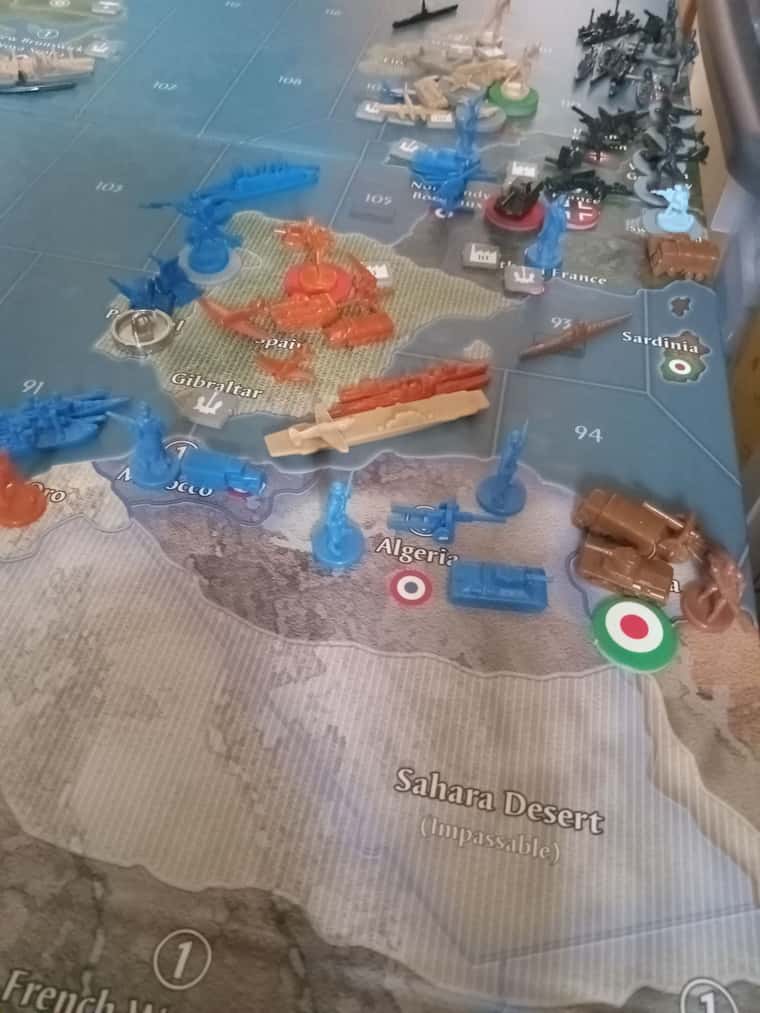
    • RE: Should we make better rules for invadable neutrals? (1940)

      @barnee I a taking a look at that 1940 expansion. Really interesting and advanced stuff in there! Definitely something I’ll read deeper later.

      posted in House Rules
      Charles de GaulleC
      Charles de Gaulle
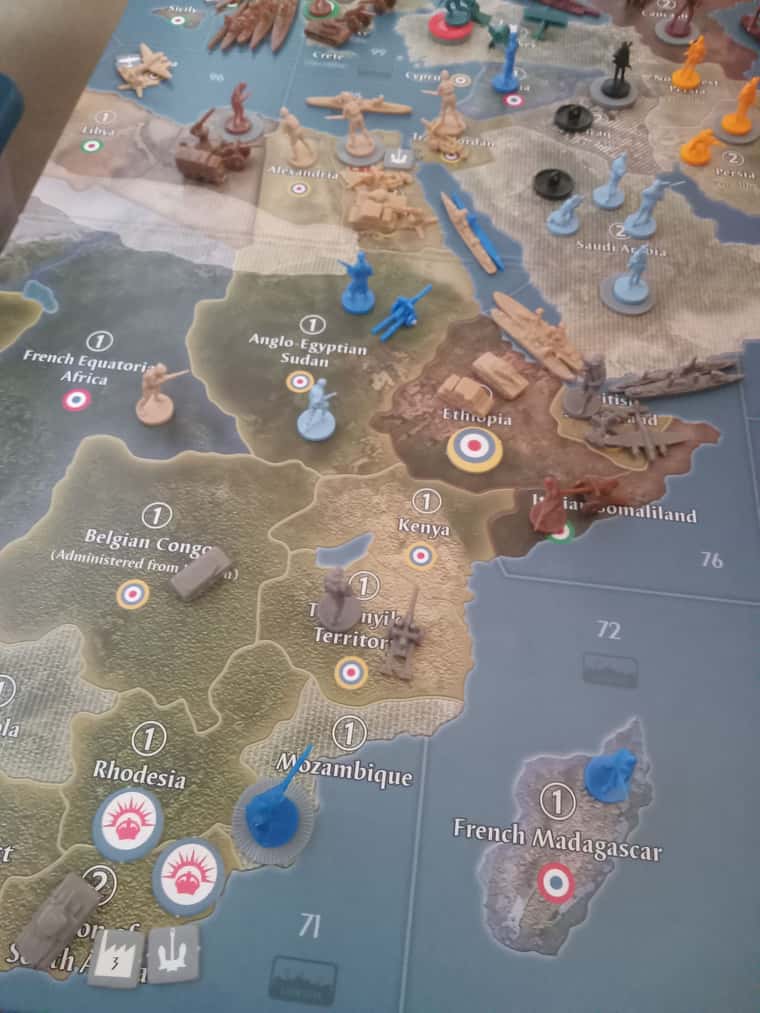
    • France building in Indo-China

      Have you ever seen a game where France actually builds units in Indo-China? I’ve never seen this happen and was wondering if it ever occurred in a real game.

      Japan typically builds an industrial complex after capturing French Indo-China, so it would only take the UK or another ally to liberate it and give France a free factory to use. Supposing Paris has also been liberated, France could very well start building in Indo-China.

      Now of course this scenario would imply that Germany has lost France, and Japan has done very poorly in Southeast Asia —making a grim scene for the Axis. Typically in my games, they would surrender after losing two very crucial areas. The only scenario I could think of is perhaps Germany and Japan are trying to destroy Russia and didn’t fare well on other fronts. Maybe France would have a reason to build in Indo-China because of this? Although Paris would likely be the better option, but games can be crazy.

      Have you ever seen this happen?

      posted in Axis & Allies Global 1940
      Charles de GaulleC
      Charles de Gaulle
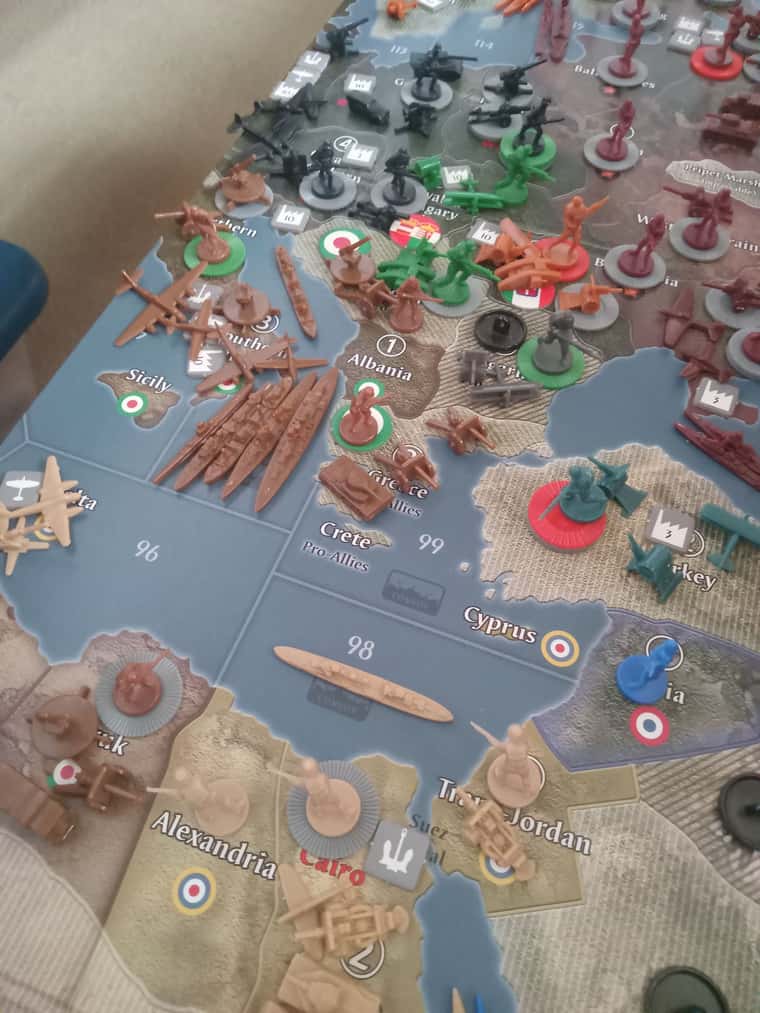
    • I Need Help! - Special Round Robin Tournament Algorithm

      While hosting small tournaments, I’ve come across an issue in creating the actual match-ups. Here are the stats and requirements that I’m working with:

      1. It’s a five player game in which turn order matters!!!

      2. Every person plays five games, one as player 1, 2, 3, 4, and 5 (you can think of this as playing 5 Pacific 1940 games, one as China, one as Japan, USA, UK, and ANZAC…)

      3. It’s supposed to be a round robin tournament, so each person plays against every other player; however, as an extra stipulation, each player will only see every other player once.

      Now according to what I just mentioned, there will have to be 21 people total (because if every player plays five games and there are four opponents in each game and every opponent will only be seen once, there will have to be 20 other people to fill those spots; this also means 21 games total will be played).

      If you’re not confused already, also remember, one of the other stipulations is that of the 5 games that everybody plays, each one has to be a different position in the turn order (in A&A terms, think of it as a different country). So there cannot be someone who plays as player #2 in more than one game, because he has to have a game as each different player position.

      -*-
      To make this a little clearer, here’s a much simpler breakdown I created for hosting a 3 player game with the same rules:

      There are 7 players and 7 games being played. The players are listed as “1,” “2,” “3,” etc. The player listed at the top of the list goes first (he is the nation that moves first) the player at the bottom of the list goes last (he is the nation that moves last).

      Game 1. Game 2. Game 3. Game 4. Game 5. Game 6 Game 7.
      ----1---------4---------6---------2----------7----------3---------5
      ----2---------1---------7---------5----------4----------6---------3
      ----3---------5---------1---------6----------2----------4---------7

      At first glance, this just looks like a bunch of numbers. But it’s actually a carefully constructed round robin tournament. Notice how it meets all the requirements I mentioned earlier:

      1. Each player only sees every other player only once.
      2. Each player gets to play only once in first, second, and last positions in the turn order.
      3. There are only three people in each game.

      Now, if you are making any sense of what I’m saying, perhaps you can help me. I have successfully created a tourney bracket like this for 4 player games, and there is actually more than one way to “solve” the match-ups so that everything is just as I said. But I’m making these through trial and error, and I’ll spare you from the headache of seeing the actual 4-player-games bracket.

      But what I really need right now is a bracket for 5 player games (the twenty-one-participant model I spoke of earlier). But with 21 different games to set up and all the stipulations I mentioned about turn order and only seeing every opponent once, I haven’t been able to manually figure out the bracket.

      Is there some sort of algorithm, formula, or something I can use other than the excruciating task off trial and error to create a list like the one I showed for the 3 player game? And yes, I am aware that many round-robin generators exist, but I’ve never found one that has support for games that have multiple players and takes into account the importance of turn order (in a game like Axis and Allies where you’re not just “white” or “the player who moves first,” where you are in the turn order makes a huge difference, as that is the nation you are playing.)

      If any of you intellectuals understand what I’m talking about, please let me know if you have a solution. My simple model for the 3 player game version is a good start, but I’m wondering if it’s even possible for the 5 player version I’m talking about? Maybe the math just doesn’t cooperate.

      PLEASE HELP!

      posted in General Discussion
      Charles de GaulleC
      Charles de Gaulle
    • RE: Oztea's 1942 Global Setup

      I TOTALLY Love this! GREAT WORK OZ!

      posted in House Rules
      Charles de GaulleC
      Charles de Gaulle

    Latest posts made by Charles de Gaulle
    • RE: Europe 1940+ Expansion Test Game (Dan/Kyle vs Twilight/Victoria/CdeG)

      Turn 4

      The Germans smashed through the Baltic States and now have a threatening mobile force there. Combined with the Finns and Germans in the north and the possibility of an attack by sea, Leningrad cannot hold out.  Dan sent many German units to Western Ukraine and made a large air assault on the Soviet industrial complex further south. His intentions on the Eastern Front are still uncertain. The Western Front has been noticeably quiet with a lone German sub sitting in Sea Zone 125 to negate the Soviet’s lend lease NO. There is still a large German air and naval presence here.
      Hungary attacked Belarus with close odds but actually fought well with 3 units surviving. A few infantry were also sent south to help the messy group of Axis units in Ukraine.

      Finland sits at a standstill, waiting for the Germans to take Leningrad.

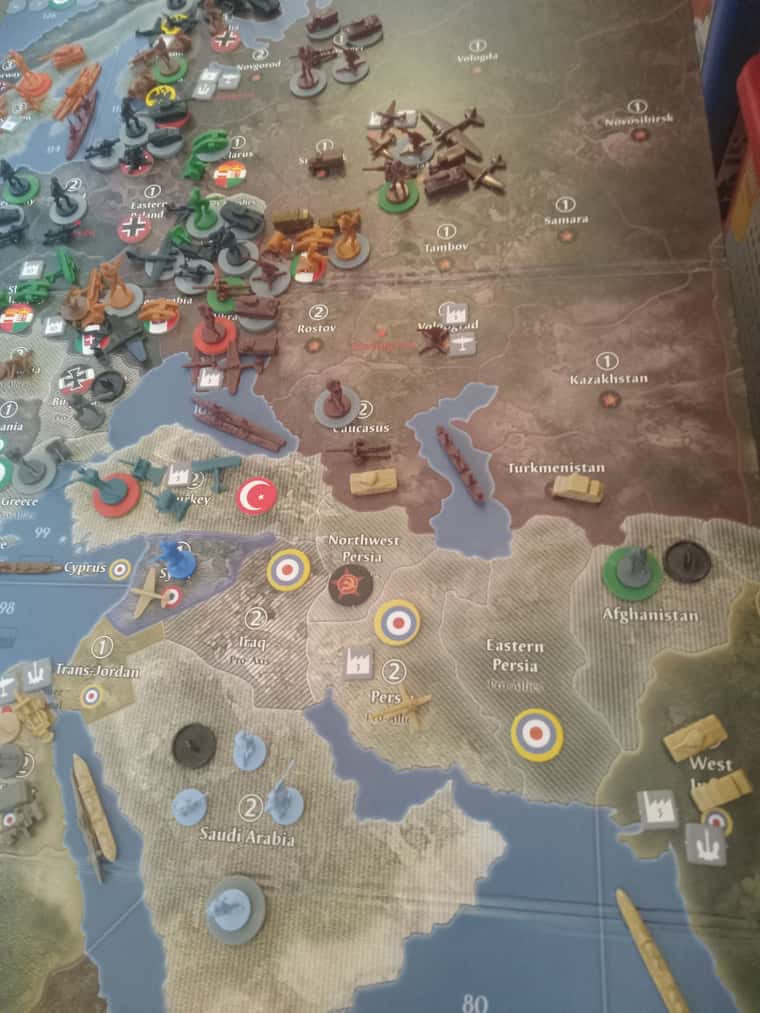
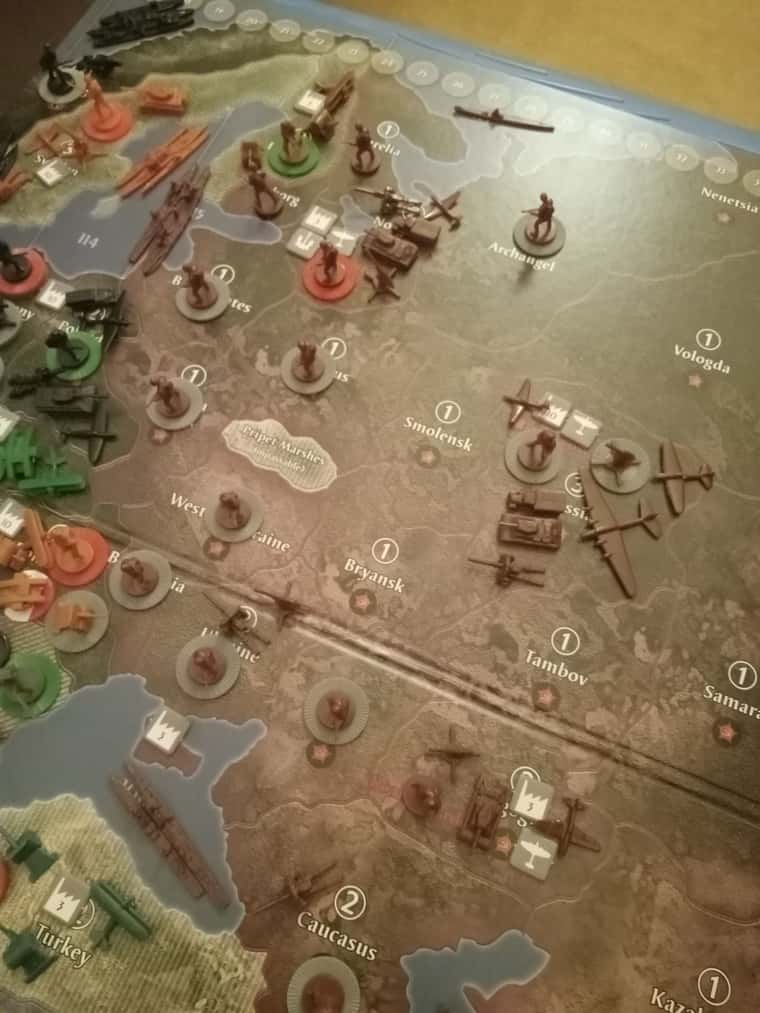
      The Soviet Union looks hard pressed, but Victoria decided to make a stand in the Ukraine. Further north, she was forced to evacuate Novgorod to avoid losing more troops. With most Axis forces in Western Ukraine, the Italians left behind in Bessarabia were an easy target for the Soviets. Victoria took almost no losses there. In sharp contrast, a counterattack on the Hungarians in Belarus failed miserably. The dice gave the Russkies no hits. This is a big deal because now German mobile divisions can be diverted into the Russian heartland or threaten Archangel. However, the Soviets do have considerable air and AA sort support to keep Moscow defended.

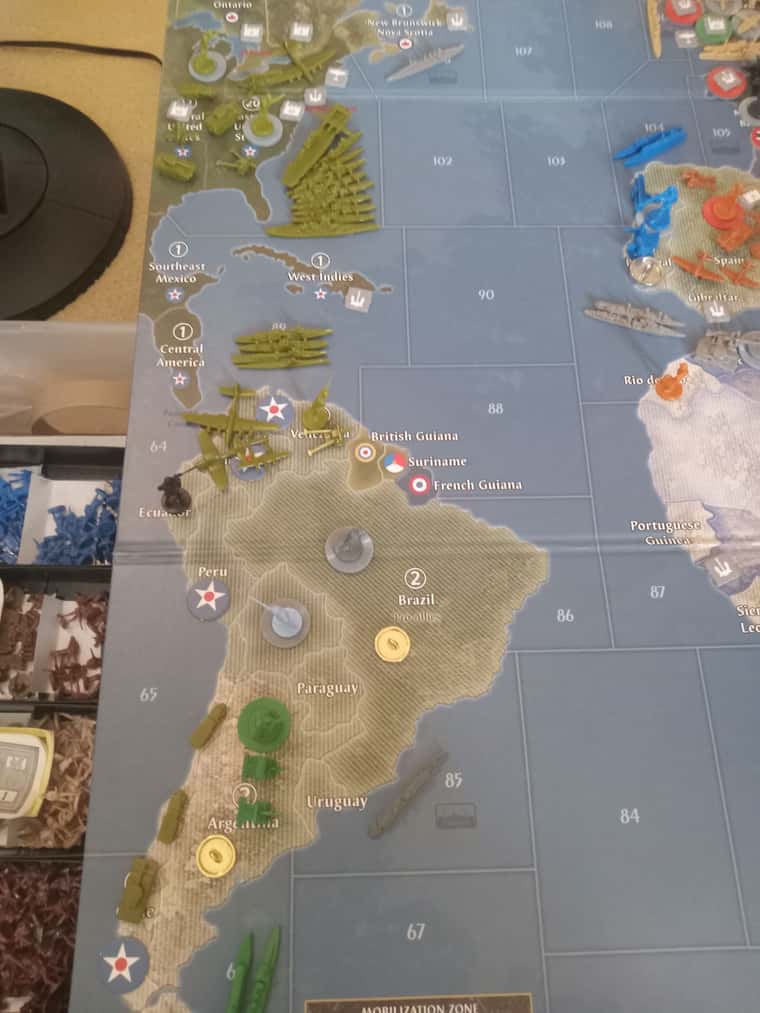
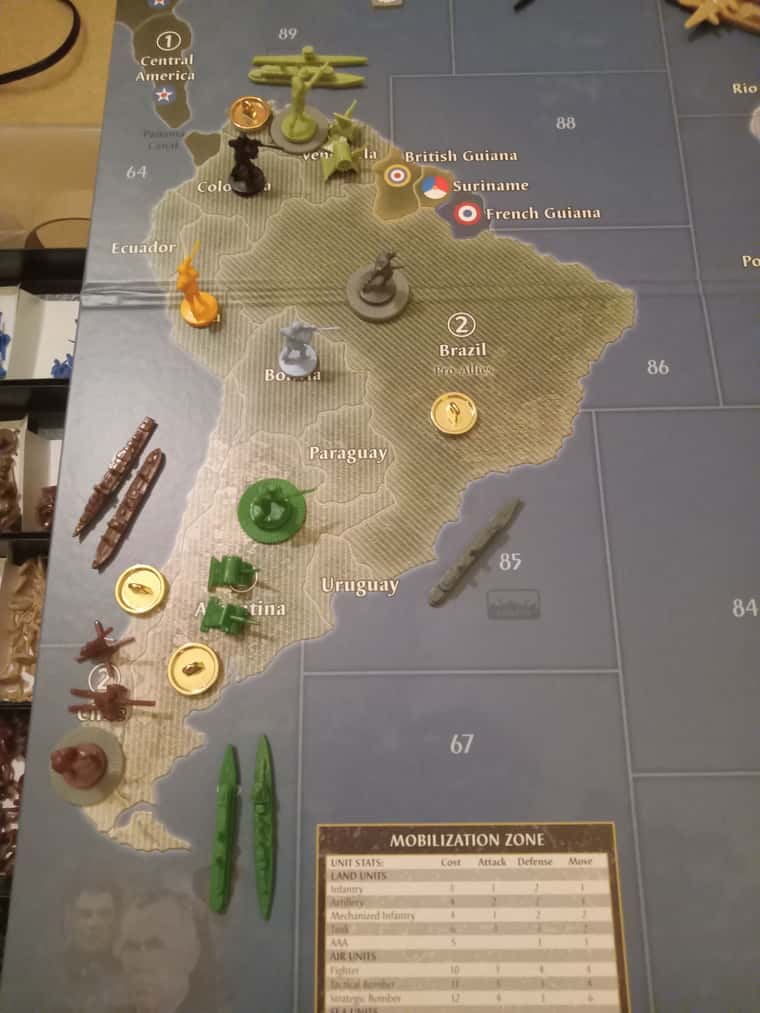
      The Americans completed their South American adventure and now control Chile and have 4 IPCs extra.  Brazil and the United States will soon join the Allies and ensure Africa doesn’t fall to Italy and France will be liberated.  The Axis need to move faster if they’re going to win. Twilight is anxious to get the Americans involved.

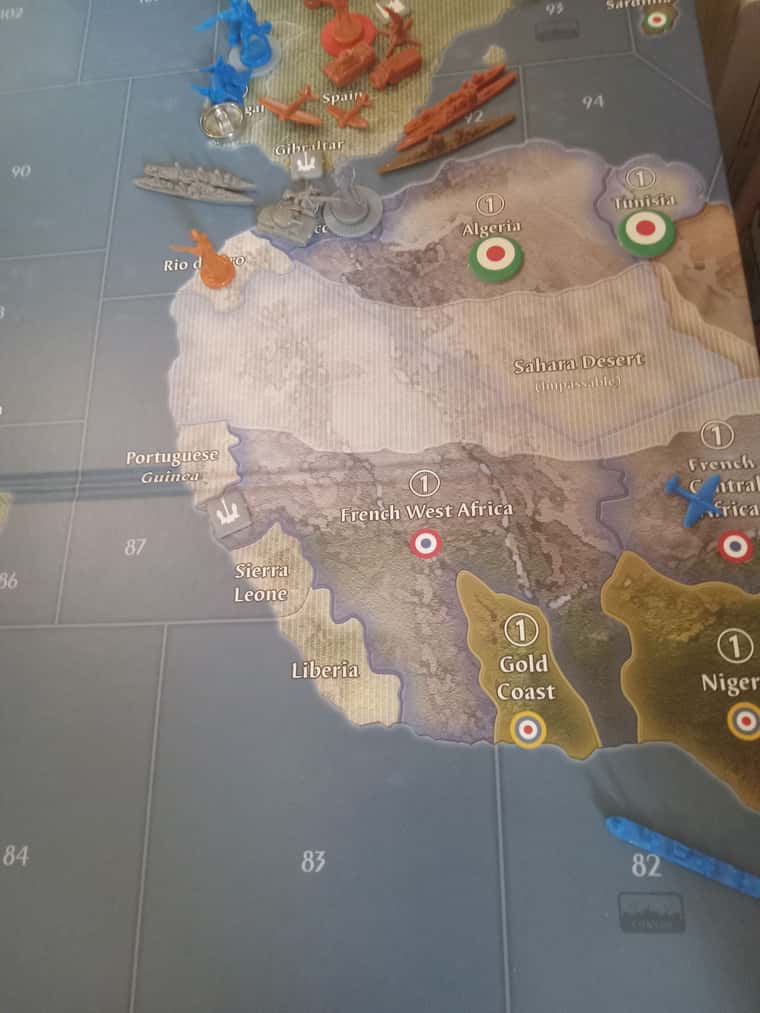
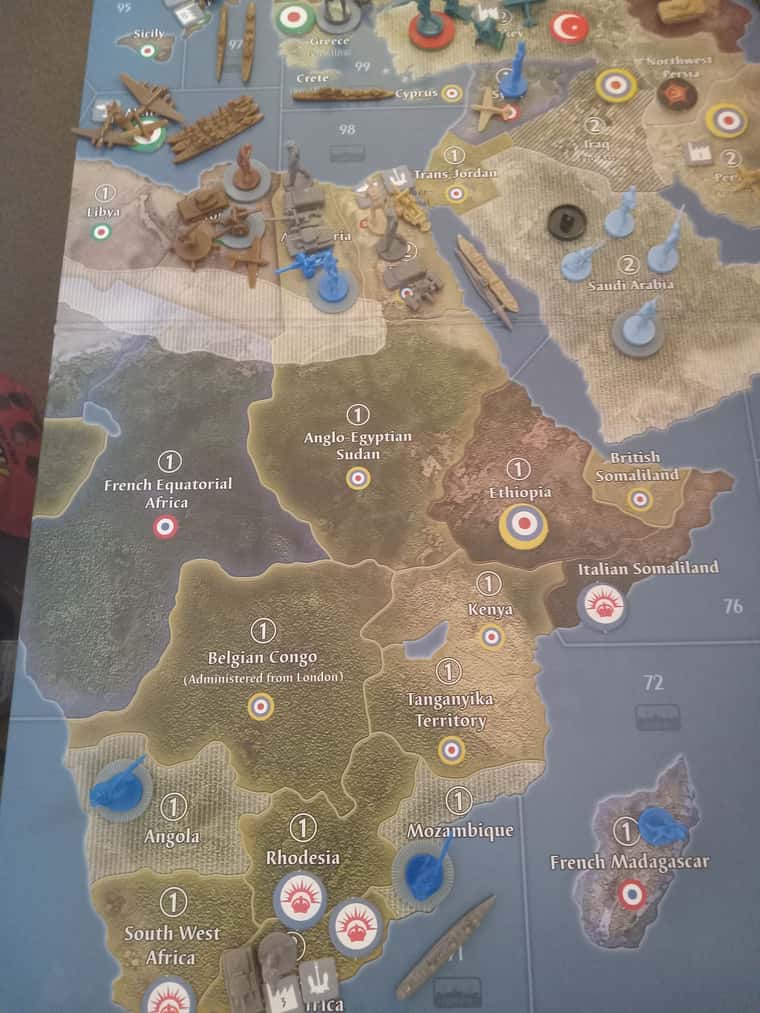
      Canada launched its own operation in Morocco, landing 4 fresh units to march east and retake North Africa. Combined with other Commonwealth forces that now form the majority of the Allies in Egypt, they may be able to squeeze the Italians in Libya to death. In a suicide attack, Twilight used his South African tactical bomber and destroyer to attack the Italian fleet to soften them up for me.

      With the United Kingdom, I attempted to put an end to the Italian navy outside Libya, but the battle only ended in mutual annihilation, with the Italian transports surviving. Those German air units on Malta gave me a very rough time. With the Middle East secure, I sent some units to the USSR (we have a lend lease rule that allows them to be converted next turn) and built a factory in Persia. India will crank out more forces, including a cruiser that is now badly needed in the Mediterranean. To divert some German forces, the British made a minor landing in undefended Holland.

      Kyle tried to take advantage of the situation in the Mediterranean with Italy by attacking the remaining Commonwealth destroyer by Gibraltar and French submarine outside Greece. The Italians achieved total naval supremacy, but an attack on Alexandria ended in retreat.  There are simply too many combined Allies in Egypt for the Italians to fight alone, especially now that they have to rely on their own air force in Malta to protect their convoys. There are still quite a few small Italian ships everywhere though.

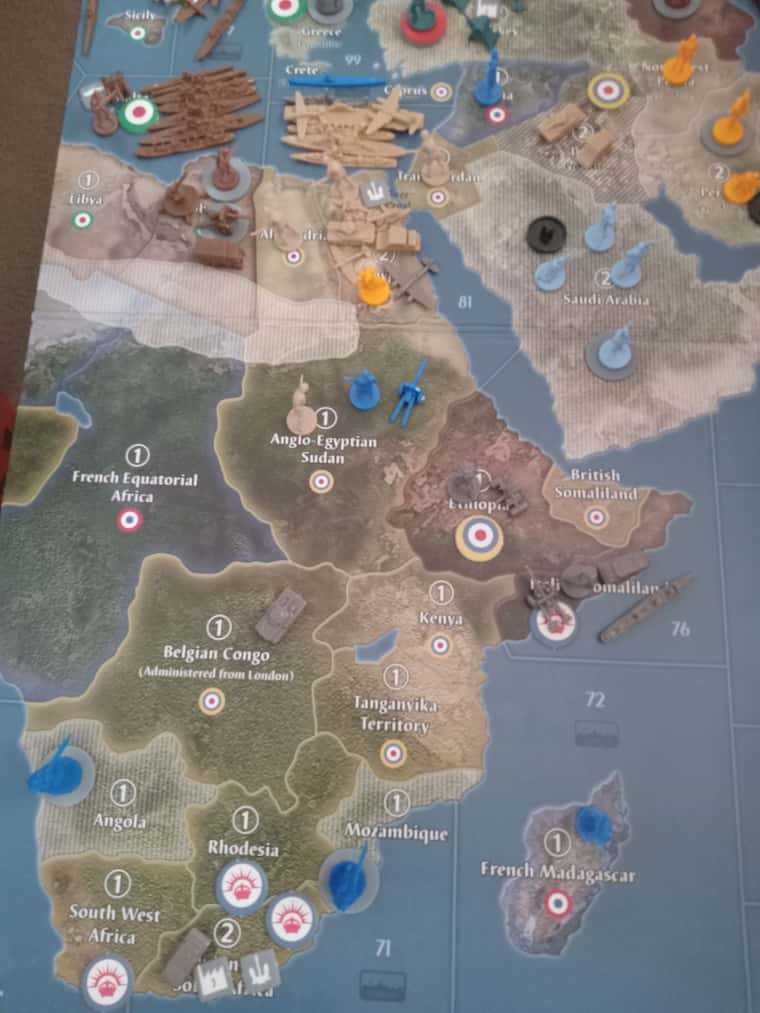
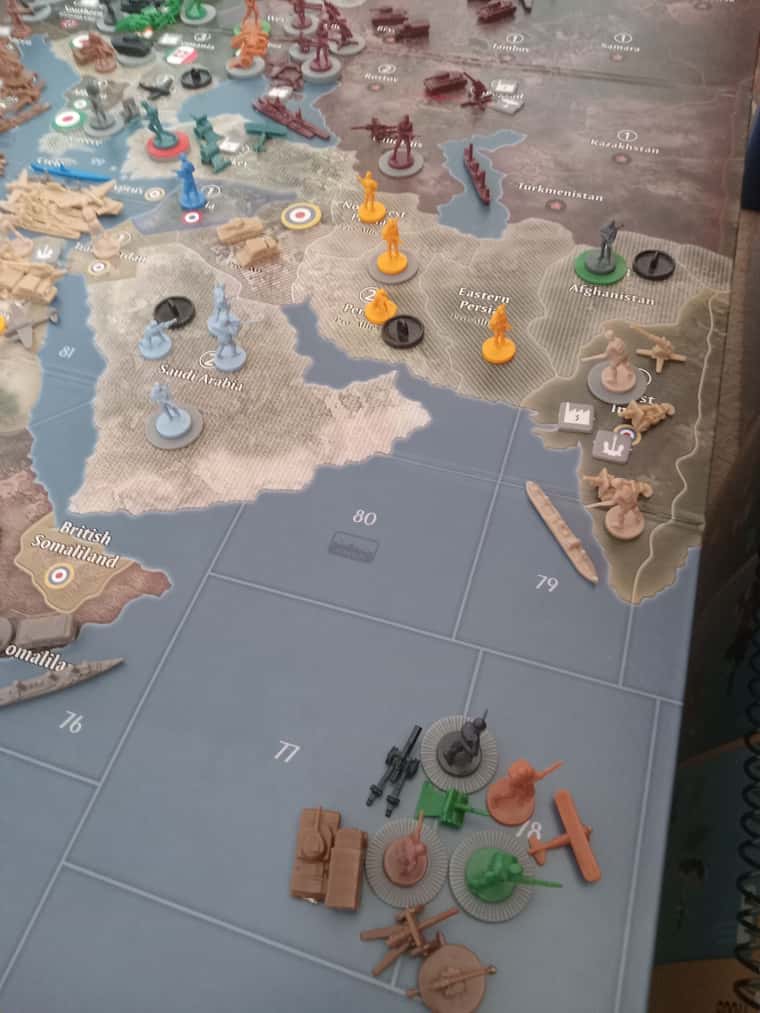
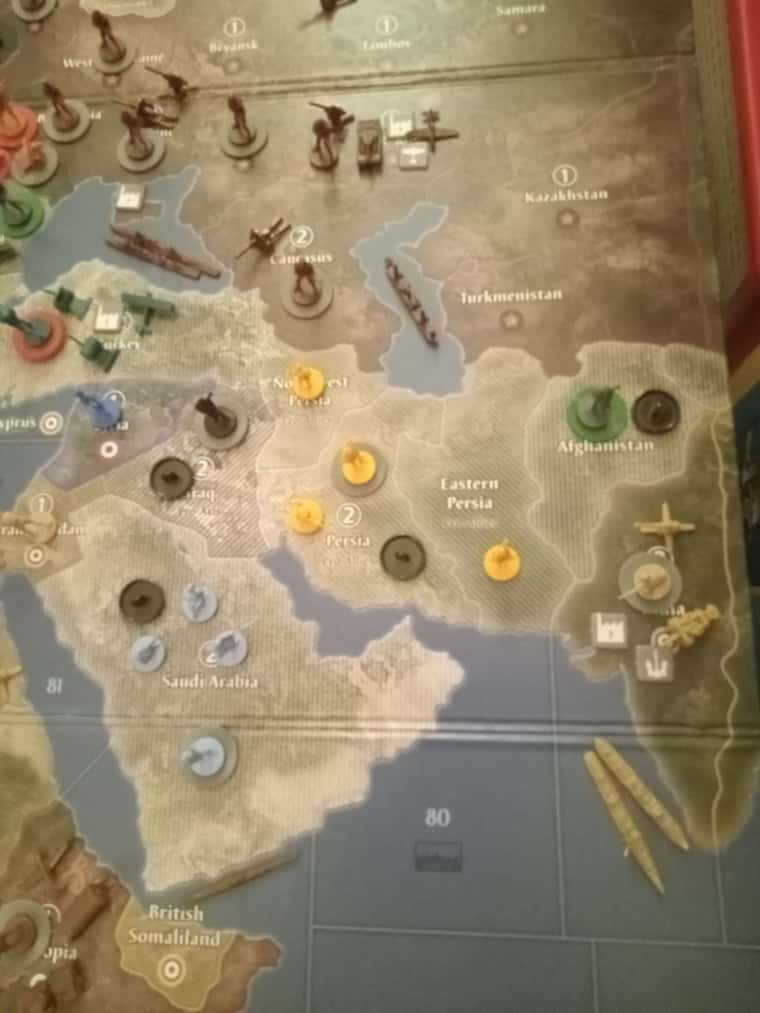
      Romania had to respond to the Soviet attack on Bessarabia. Holding this territory is their only NO. But like the Italians before them, they took heavy casualties fighting here. Kyle made a real game-changer further east with the Romanians, taking Bryansk deep in Russia. Since the Hungarians were able to hold Belarus, Dan could now move all his German armor right onto Moscow’s doorstep while simultaneously threatening Ukraine.  A crisis might unfold in the Soviet Union. Victoria’s only comfort is knowing the messy conglomeration of Axis forces cannot attack in unison. She might be able to hit them hard from behind and build a massive stack in Moscow. Twilight said he’s not used to seeing such an uneven front line in Axis and Allies without disaster unfolding for someone.

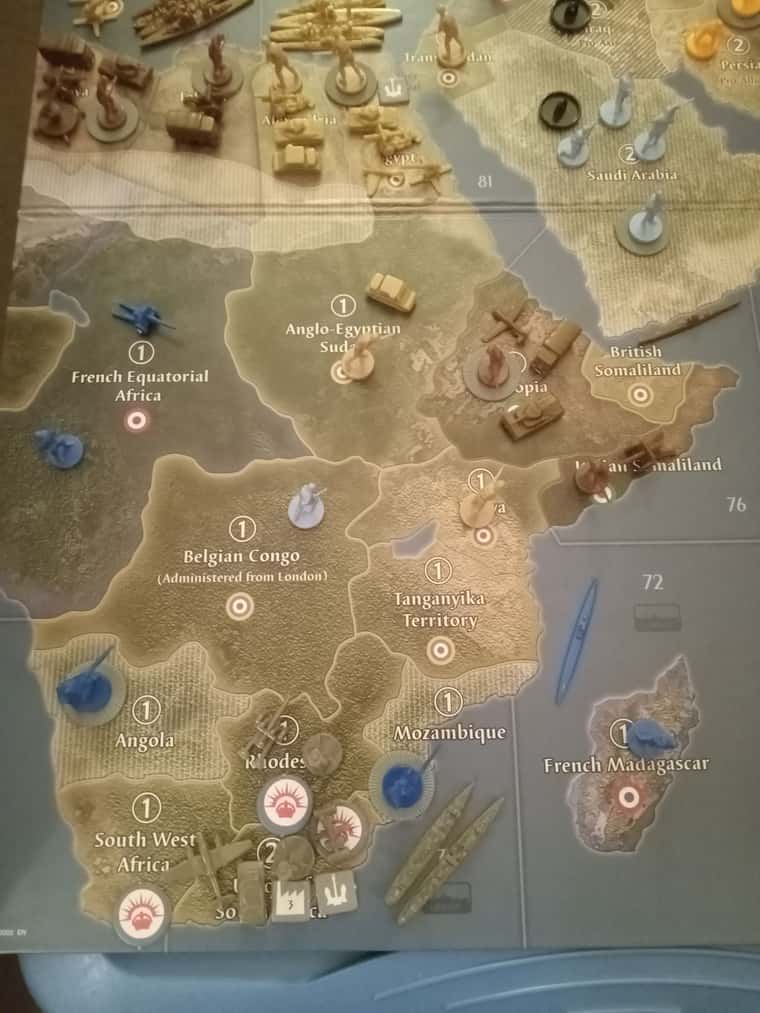
      Most of my French units are dead, but I’m sending a transport and fighter around Africa to help the small desert force fighting in Libya. I have an infantry in Madagascar to bring up too. Home feels very far away. 20230729_191935.jpg 20230729_191947.jpg 20230729_191957.jpg 20230729_192011.jpg 20230729_192028.jpg 20230729_192036.jpg

      posted in Blogs
      Charles de GaulleC
      Charles de Gaulle
    • RE: Europe 1940+ Expansion Test Game (Dan/Kyle vs Twilight/Victoria/CdeG)

      Turn 3

      To kill the Canadian bomber in Scotland, Dan launched a small amphibious assault there against very little resistance. This took most of the German fleet away from being able to attack the USSR, but 2 transports and some smaller ships are still near Denmark and landed 4 new units in Norway. This included 2 fast divisions to reinforce the artic army in Finland. An attack on Karelia was very costly for the Germans. The much broader assault on the USSR’s western border surprised me. Instead of putting most of his force in the north or south, Dan sent almost all of his mobile units to Eastern Poland and only took the Baltic States with a small army. Bessarabia is not empty. The pile of units in the Indian Ocean is the large international force there, including some Germans. Both Romania and Finland have received German air support to protect against potential bombings they wouldn’t have the IPCs to be able to repair.

      Finland took Vyborg easily and reinforced the artic army in Karelia.

      Hungary has assumed a support role and is acting as a deterrent to Soviet counterattacks.

      Victoria attacked the Baltic States (the weakest link in the Axis advances) with the Soviets. To prevent an Italian or Romanian can-opener, she was forced to leave some troops in Belarus. Leningrad is holding on by a razor’s edge, but half the German fleet being outside Scotland might make it last another round or two. A cruiser in the Baltic Sea prevents an attack on Leningrad from the west, but an attack through the White Sea in the north is still possible. Ukraine has been consolidated to hold another round. Even though the Germans have a large force in the center that could theoretically march on Moscow, one disadvantage to Germany having to rely on minor powers is the necessity of split attacks. The Soviets can defend in mass, but the Axis cannot attack together. The USSR also took Northwestern Persia, which might seem silly, but we have a house rule that allows Allied lend-lease units to be converted to Soviet ones once they’re on Soviet controlled territory.

      The Americans continued their South American adventure and took Peru without loss. Venezuela was much more bloody though. Chile seems to be in danger now. In the long run, Twilight hopes for these IPCs to make the losses worthwhile.

      Twilight didn’t trust leaving his Canadian troops on my British transport and decided to leave them in Iceland for now. He was annoyed with the loss of his bomber and built a new one. Commonwealth forces are now playing a big role defending Egypt. Italy faces harsh odds in North Africa.

      With the British, I completely overran Persia and prepared to start sending forces north to help Russia. Italy’s navy almost forced me to evacuate the Mediterranean, but a bright idea struck me—an air base in Egypt to let us scramble planes there. Once again, an Italian attack would have really close odds, so I felt bold enough to make a stand. With Commonwealth and French units in Egypt, I decided to move the British army up to Alexandria. Not much happened in the UK. I liberated Scotland from the small German attack and built a destroyer.

      Romania moved forward on the Eastern Front and has a decent sized army in Western Ukraine. It won’t survive without German reinforcements though. Romania is quickly becoming comparatively rich for a minor power.

      Kyle responded to my stubborn Royal Navy near Cairo by building more ships and used his Italian army in Libya to attack Alexandria. The battle ended in mutual annihilation with only the Italian Air force surviving. In Eastern Europe, Italian units killed the Partisan in Yugoslavia and reinforced the Romanians fighting in Ukraine. With the cover of a large Italian navy and German air force on Malta, Kyle can send 4 ground units to Africa every turn. One of us has to attack soon.

      I lost 2 French ships in the Mediterranean, but I’m satisfied that they did their job distracting enemy forces. The long fight in north-west Africa is over. I attacked with 2 French infantry and a fighter versus the 2 Italian fast units; all 4 land units died and my French fighter is in Gibraltar now. The French are on the front lines in Egypt, and I managed to convince Twilight to let me bring Canadian troops to Morocco with a French transport. They’ll probably sink, but it’s at least a distraction using forces that can’t do anything else at the moment.

      We’re all very curious what Dan will try next on the Eastern Front, although I’m pretty sure Kyle is demanding that he send units south to help the Romanians.

      20230723_152339.jpg 20230723_152345.jpg 20230723_152404.jpg 20230723_152440.jpg 20230723_152455.jpg 20230723_152506.jpg

      posted in Blogs
      Charles de GaulleC
      Charles de Gaulle
    • RE: Should we make better rules for invadable neutrals? (1940)

      @SuperbattleshipYamato In other variants we have allowed neutral superpowers to invade minor neutrals, and although I wouldn’t suggest it for a basic neutral expansion, it won’t hurt much. Venezuela is pretty much the only nation the U.S. could attack without violating its naval restrictions.

      I would go ahead and allow it. Makes things more interesting.

      posted in House Rules
      Charles de GaulleC
      Charles de Gaulle
    • RE: Europe 1940+ Expansion Test Game (Dan/Kyle vs Twilight/Victoria/CdeG)

      Turn 2

      Dan launched a combined amphibious assault and overland attack on my French units in Normandy with the Kriegsmarine. His navy now sits in the English channel. Germany also made an enormous Battle of Britain and caused massive damage (21 total to all three facilities). It came at the cost of a tactical and strategic bomber, but Germany still has 13 planes. Armored units have been sent eastward to Germany and Yugoslavia, making it obvious what will happen next turn to the Soviets. Romania isn’t empty. That stack of German, Italian, Hungarian, and Romanians you see in the Indian Ocean is the large international force there.

      Hungary removed its forces from Yugoslavia in preparation for an attack on the USSR.

      Finland faces way more Soviet forces on its border than it can handle alone, but Dan sent a significant German arctic army to assist them.

      Despite Germany having 3 transports in the Baltic Sea, its navy is in no position to attack the Soviets. Victoria might be able to hold Leningrad for a little while, but that massive stack in Poland could easily march north. I asked her why she left 12 infantry on border territories. With Germany relying so much on minor powers now, she said she hopes to attract some small battles and counterattack weak parts of the front. It does look like the Axis are going to attack all along the front and not pile too much into single territories. We’ll see how that goes next round.

      The United States has invaded Colombia in preparation for taking over Venezuela. Oil jokes were made. Even though we are letting the Americans invade neutrals, Twilight cannot activate Brazil with American units since the USA isn’t considered to be an Allied power yet. Moving into Brazil would actually require fighting those Brazilian forces.

      Canada has finally set sail. The two German subs in the Atlantic went after my British destroyer between Greenland and Iceland. This move enabled Twilight to send a Canadian bomber and destroyer after them. We are now using the Arctic Ocean to ferry Canadian troops with some aid of the Royal Navy.
      Commonwealth forces in East Africa crushed Somalia. They haven’t lost anything here yet and now have a decent army to send north to fight in Egypt. Their destroyer and tactical bomber are already there helping me immensely.

      The massive damage to London would have concerned me if Germany had built more than 4 transports and not made it obvious that the USSR was their priority. For the British, I still played it safe though and made a huge stack of infantry in the UK. The Mediterranean was way more exciting. I decided to combine all my naval units outside Egypt and challenge the Italians. Kyle could have tried attacking this, but it was extremely close odds and likely would have been gone to whoever rolled more luckily. I took out Iraq without much difficulty and set myself up to invade Persia next round. Egypt looks safe, but…

      Italy did something I should have seen coming. Kyle took over Malta to invalidate my empire NO, but since there’s an air base there in this variant, he can rely on German planes coming to cover his fleet. He only has 7 units in Libya though, and it’s going to take way more than that to make up for all the Allies that can converge on Egypt. Italy sent an army to the Eastern Front and built some more small ships.

      One thing I didn’t mention earlier was the fact Dan did not take Southern France as Germany. While I understand he might have wanted to save Italy some money, there was an Italian submarine in SZ93 that could have reached my British fleet outside Egypt had the naval base there been Axis. It would have swayed my decision to make a stand with the Royal Navy.

      Bulgaria replaced Italy as the occupier of Greece. Bulgaria can also “donate” units to other Axis powers since they aren’t really able to fight all that much (can’t declare war on the USSR). They are best used to keep Yugoslavia in check and Greece defended.

      Romania actually began the war in the east with a full-scale attack on Bessarabia. Unlike Hungary and Finland, Romania moves after the Soviet Union in the turn order and can declare war before Germany does and set up can-openers. We will have to see how much the Axis reinforce the Romanians here, otherwise Victoria is going to send the Russkies to crush them.

      Italy took Southern France, and much to my disappointment, also Algeria. While I realized I would likely fail here, Kyle only sent his 4 land units in Tunisia and 1 bomber from Italy against my 4 in Algeria and still only lost 2 units. I had hoped to distract more air power or take down most of his army.

      I felt obligated to make another stand in Morocco and sent my fighter from the UK to assist. If he wants to get the North Africa NO, he’ll have to send more than just his remaining 2 fast units and a bomber next time. With the French navy, I scattered it quite a bit. One destroyer went north to sink a German sub by Wales. My 2 submarines are in the Mediterranean in convoy zones. I’ll either distract Italian destroyers or get some IPCs off Kyle. I also have a cruiser guarding Gibraltar and Morocco from a possible attack by sea. A French transport went to Canada to help further with getting men across the Atlantic.

      These first two turns were tremendously fun, and the Eastern Front looks ready to explode.
      20230722_185743.jpg 20230722_185803.jpg 20230722_185827.jpg 20230722_185854.jpg 20230722_185902.jpg 20230722_185952.jpg

      posted in Blogs
      Charles de GaulleC
      Charles de Gaulle
    • RE: Europe 1940+ Expansion Test Game (Dan/Kyle vs Twilight/Victoria/CdeG)

      Turn 1

      Germany takes Normamdy and Paris, but does lose a lot of infantry and a plane.  Dan (playing as Germany, Hungary, and Finland) managed to sink all of the British navy and even have 5 sea units floating in the Atlantic.  Even after British and Candian counterattacks, 2 German subs are still alive. He built an aircraft carrier and added a battleship and a cruiser from the Baltic Sea.  In the east, a massive German stack is in Poland, and Hungary and Finland have received German garrisons.

      Since Germany didn’t attack Yugoslavia, Hungary tried to and actually had very good luck, picking up an extra 2 IPCs.

      Finland is not an Axis power and operates under special rules. For instance, Finish control of Leningrad does not count as a victory city for the Axis.

      Victoria (playing as the Soviet Union and Yugoslavia) left a surprising number of Russian troops on the border and threatened Finland. If Germany goes for Sea Lion, it might be over for them. The Soviets are allowed to attack neutral territories like Turkey in this variant.  Persia is a neutral nation now as well.

      The U.S. can also attack neutrals, but must keep its sea units adjacent to original American territories.  Twilight (playing as the United States and the Commonwealth) sent a couple men to Central America, eyeing the IPCs available in the south.  Since this variant gives the Axis a lot more enemies to fight, the U.S. is not allowed to declare war until the collect income phase of turn 5.

      The Commonwealth (an independent entity representing Canada, South Africa, and ANZAC) lost a Candian destroyer and transport and can’t safely send any help across the Atlantic until we sink those subs. I, Charles de Gaulle, (representing the United Kingdom, France, and Greece) did send a cruiser and transport to Canada to help their new destroyer Twilight built.
      In Africa, the Commonwealth sent men to East Africa and sank an Italian submarine.  Those poor Italians there are really surrounded now.

      As the United Kingdom, I want to tempt Dan to try Sea Lion. I got bad luck sinking a German destroyer and cruiser by Scotland and lost 2 planes.  I also decided to be cautious in the Mediterranean and only sank 1 of the 3 Italian fleets. Italy is quite strong in this variant, but does have to deal with the French in the west and the Greeks in the east. I sent my battleship to Ethiopia and destroyed the Italians there. I left my carrier by Gibraltar for flexibility and will wait to see what Germany does. I have the French and Greek fleets to distract Italy for now and can regroup next round.

      Greece begins the game neutral and can’t do anything until turn 3 unless it’s attacked.

      Bulgaria has a “micro” industrial complex.  These can build 2 infantry or 1 of any other unit (except bombers and capital ships).

      Yugoslavia deployed a partisan.  This annoying unit spawns every turn and must be destroyed by the Axis in order to maintain free passage through the territory and the 2 IPCs.

      Kyle (playing as Italy, Bulgaria, and Romania) took advantage of my conservative British attacks and sent his smaller ships and planes after the French and Greek navies. The Italians easily destroyed the partisan infantry in Yugoslavia, and Greece was absolutely crushed by an attack by land and sea. However, Kyle left Southern France alone.  I believe it was a big mistake. Interestingly, he’s sent his army in Libya to attack Tunisia and left the Egyptian front as a standstill like I did. The two Italian units left in Somalia are doomed.

      For France, I was very excited to fight hard. Kyle not attacking Southern France let me destroy Dan’s German survivors in Normandy. I sent up help from West Africa to Morocco and made a stand in Algeria against the Italians. I have a small fleet by Gibraltar now. My fighter escaped to London to help out there, and other scattered units are going to help in Egypt.
      20230716_180544.jpg 20230716_180622.jpg 20230716_180637.jpg 20230716_180652.jpg 20230716_180706.jpg 20230716_180721.jpg

      Please note that some units are from other games since we have so many countries. Neutral nations are independent of each other and get their own armies. Some things might look a little confusing, like Soviet units being used to represent Chile or Japanese ones being used to represent Sweden and Spain. But they’re all independent nations.  If you see a 1914 artillery upside down, that’s what I’m using as a AA gun for some minor powers.  I like mods, but I have also invested very little into them, as you can see.

      posted in Blogs
      Charles de GaulleC
      Charles de Gaulle
    • Europe 1940+ Expansion Test Game (Dan/Kyle vs Twilight/Victoria/CdeG)

      Greetings
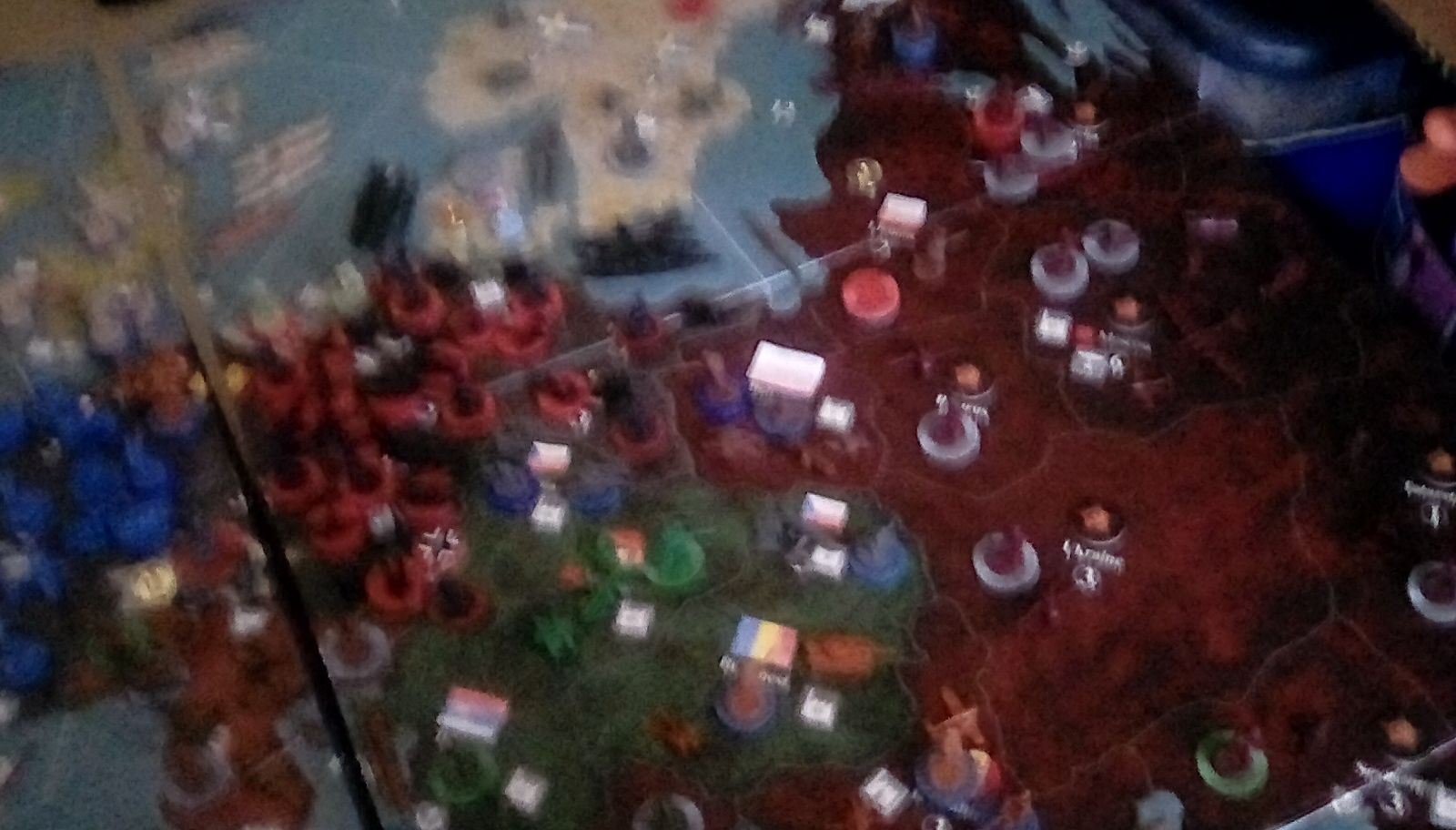
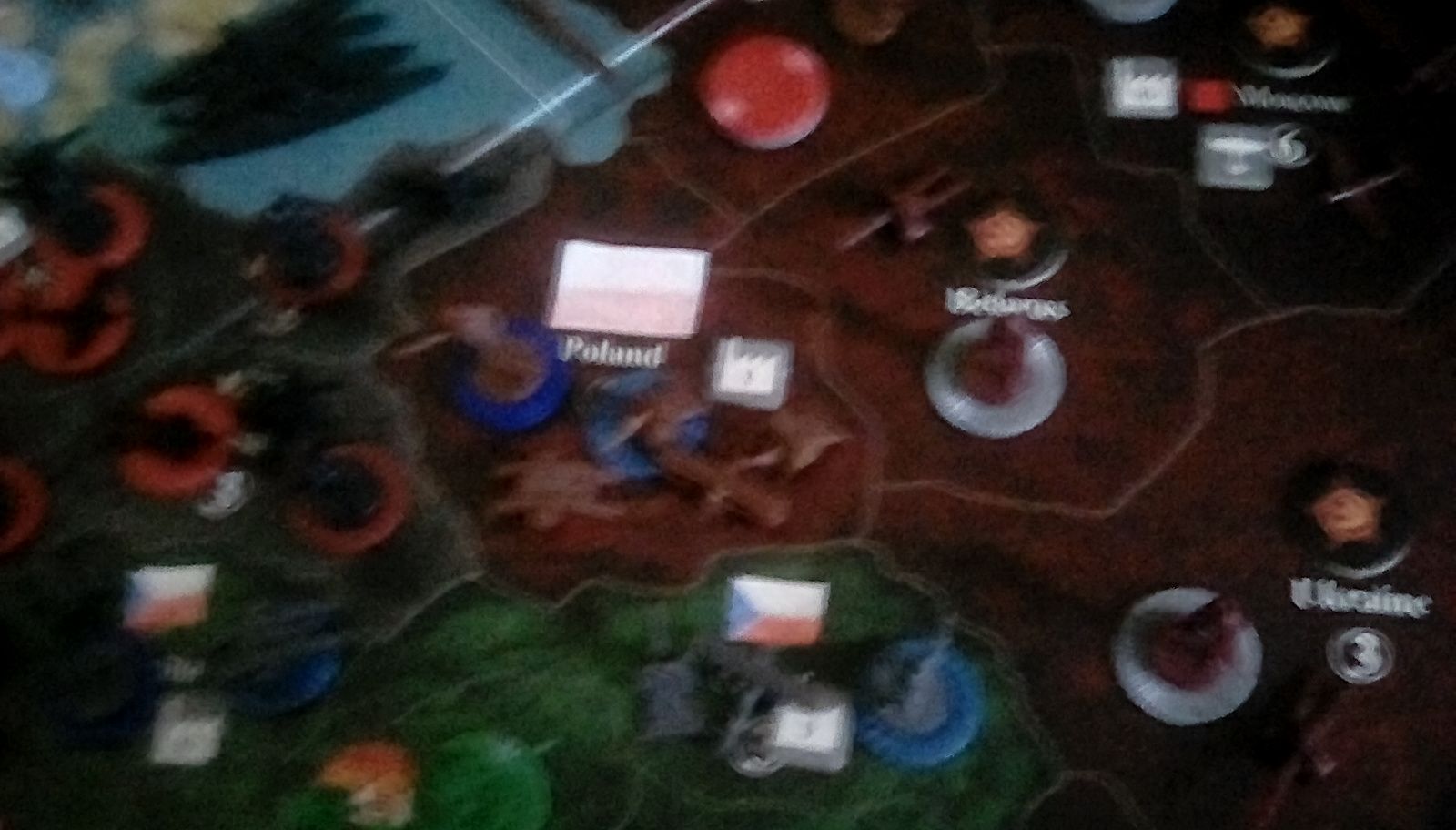
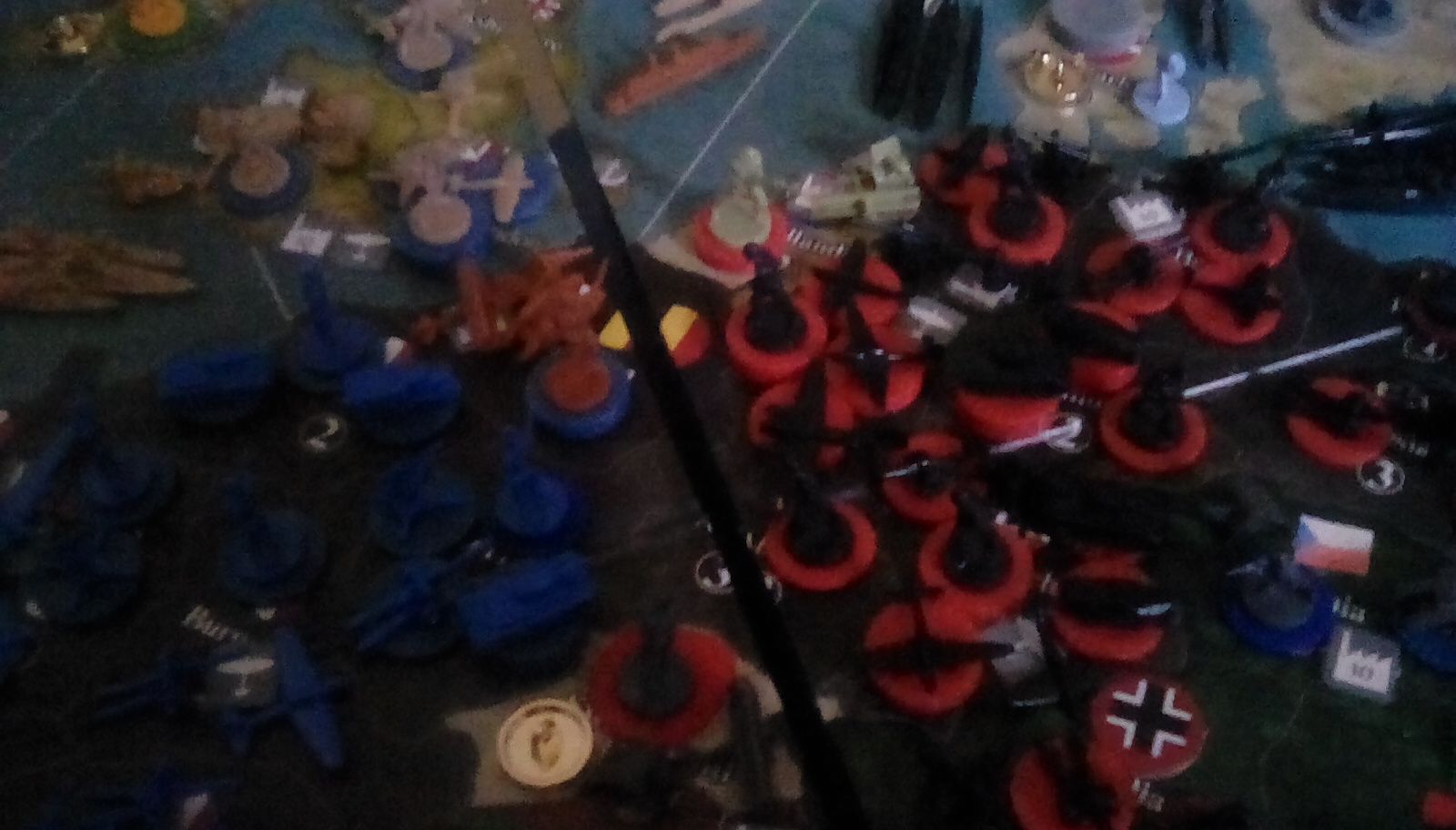
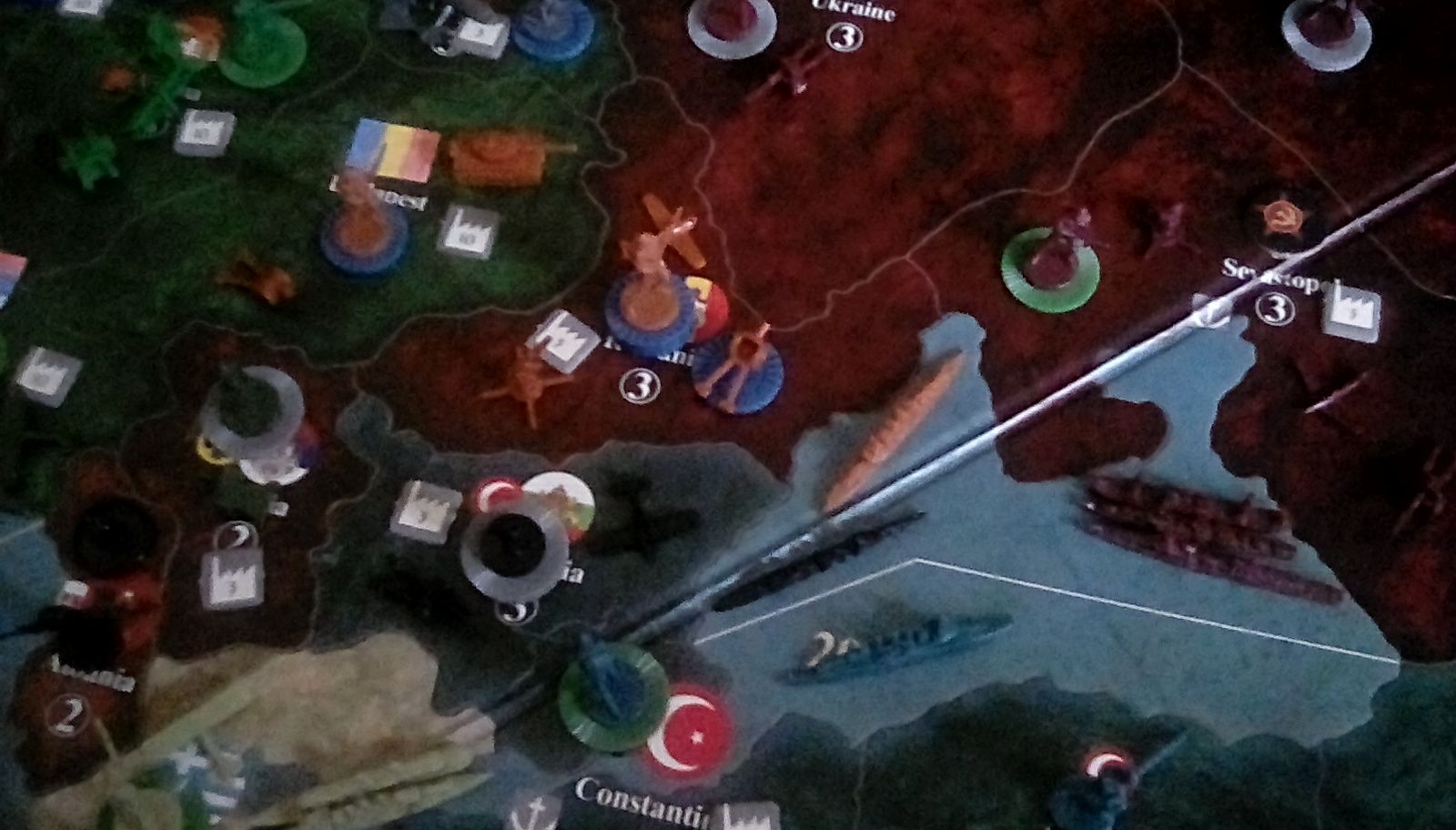
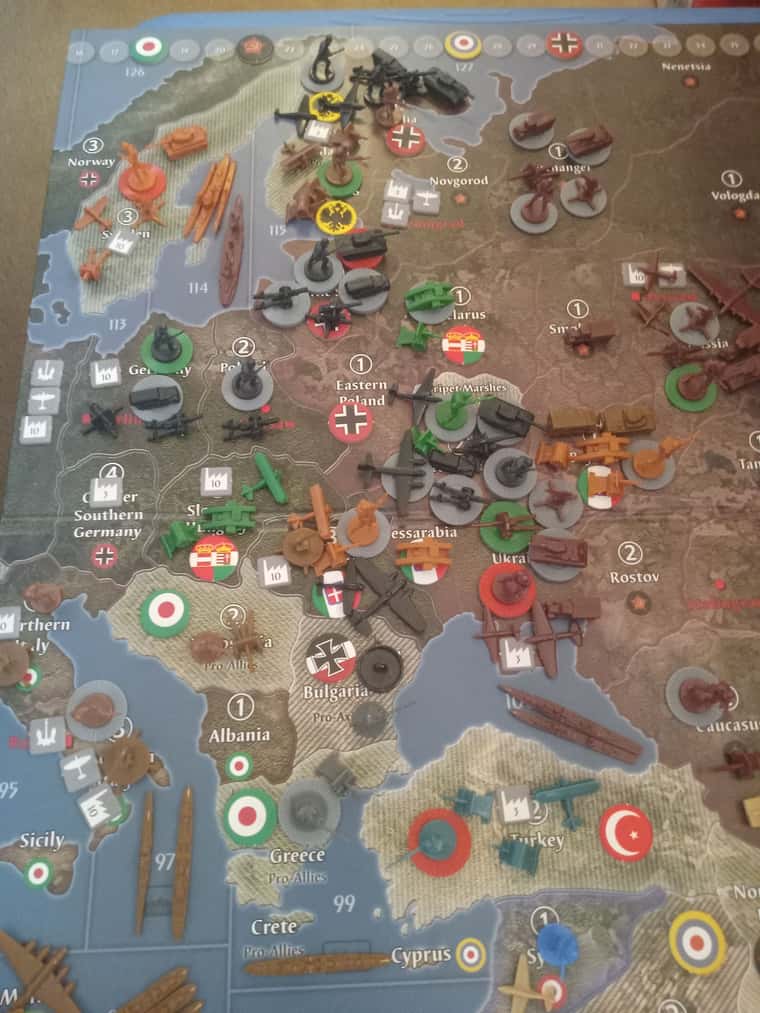
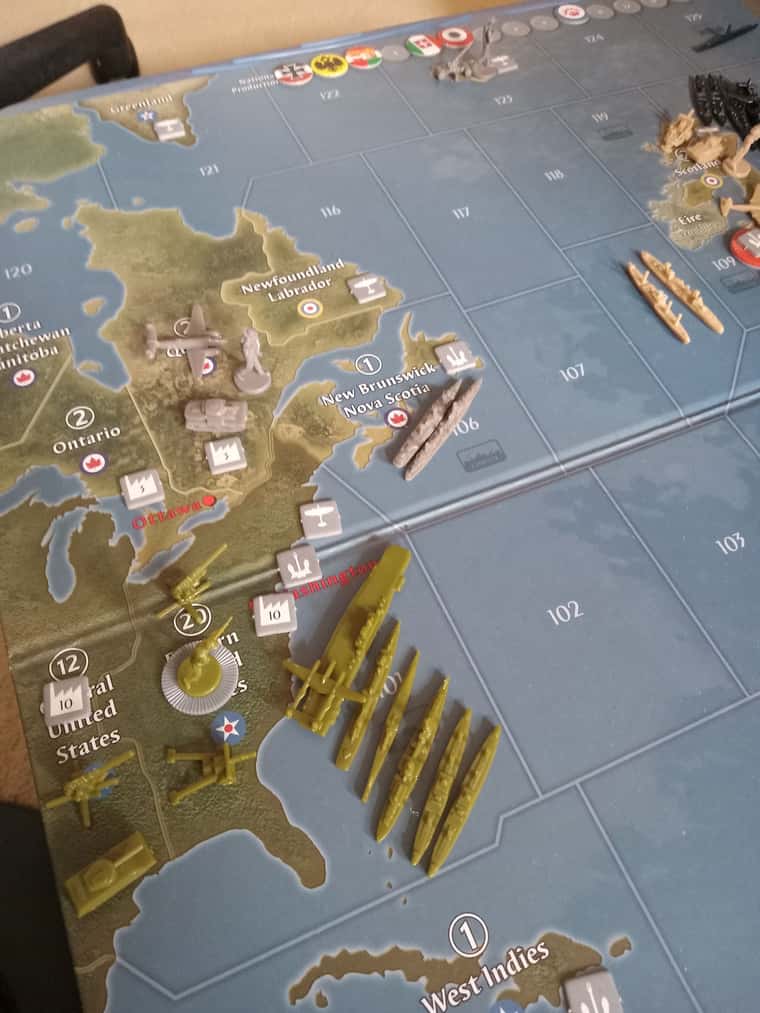
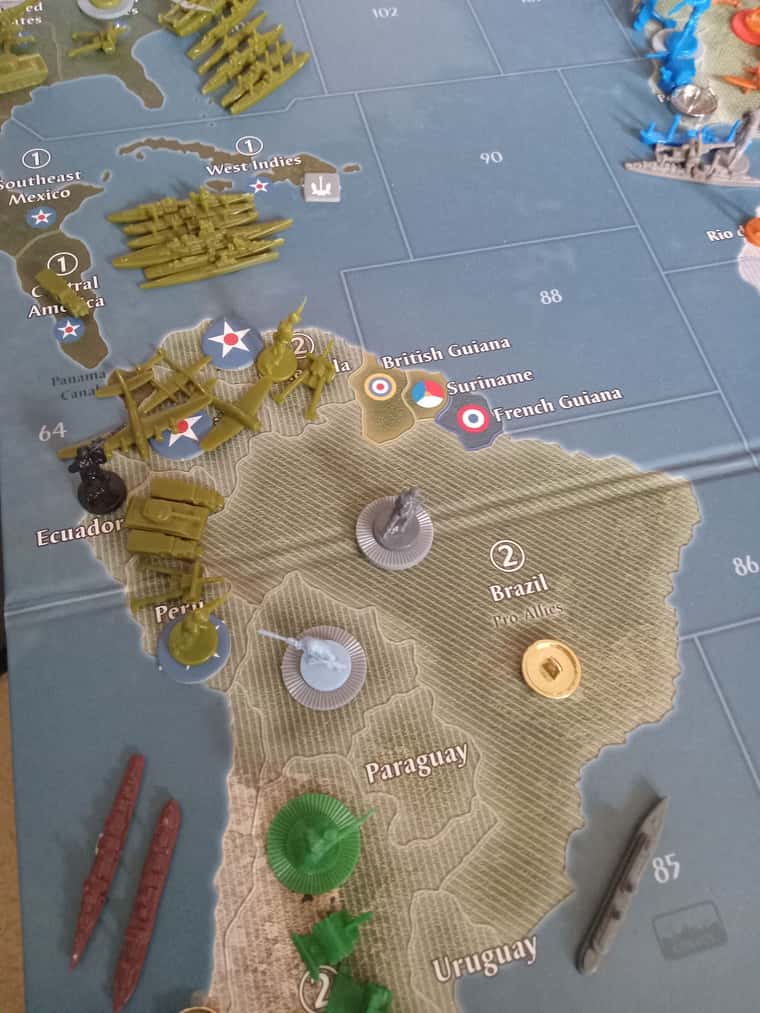
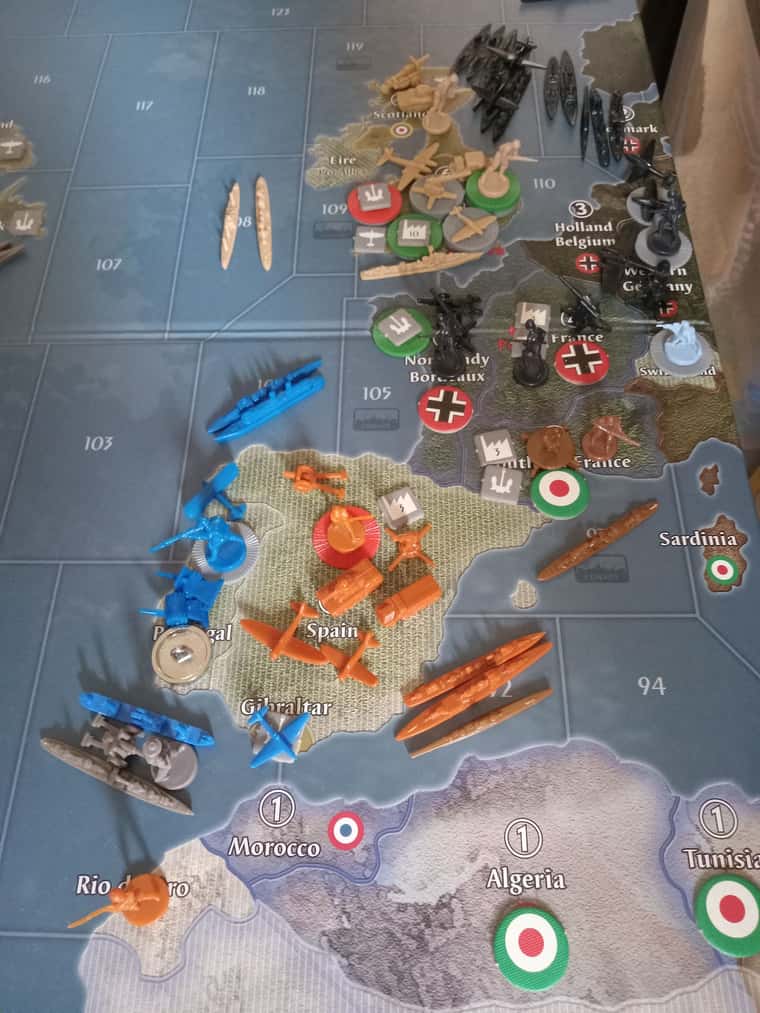
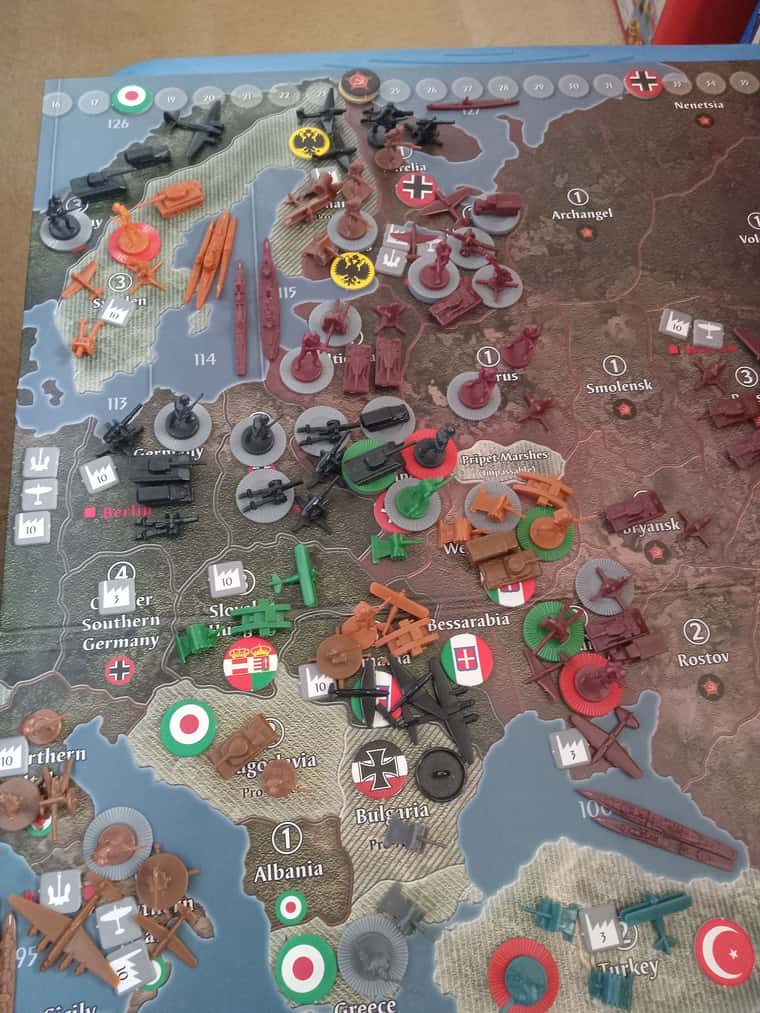
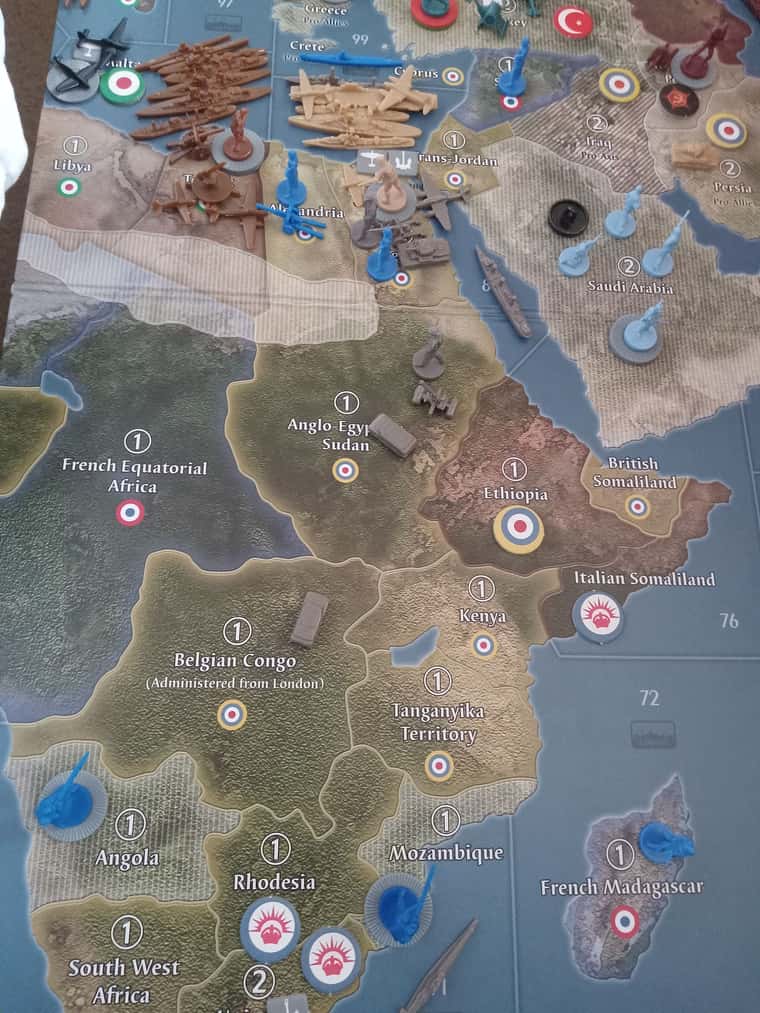
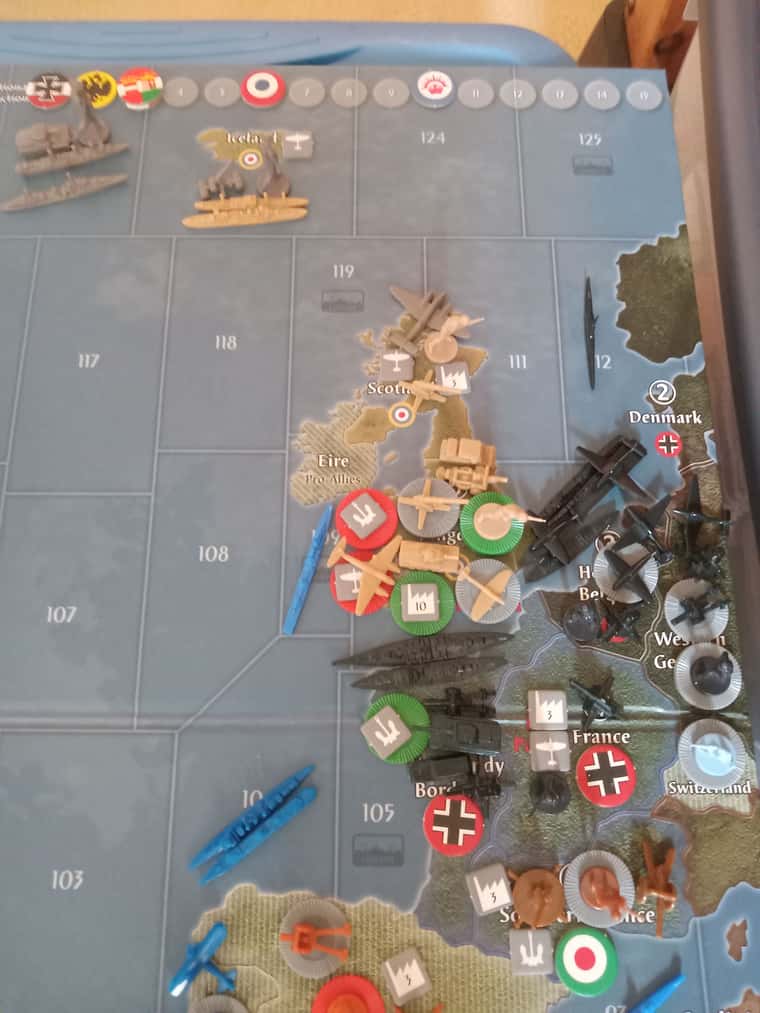
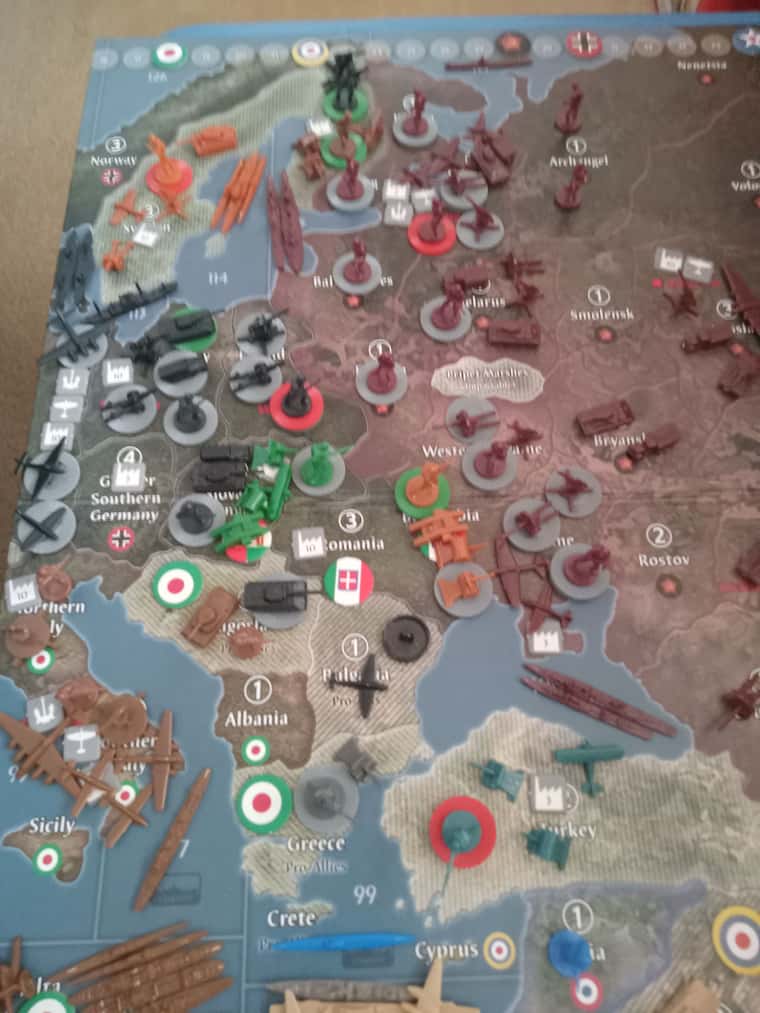
      This month we are testing an unnecessarily complicated A&A Europe 1940 spinoff. I’ll save you the headache of explaining any further and instead show you what it looks like. You’ll have to excuse the fact I have the boards split. Life has been crazy.
      20230715_203618.jpg 20230715_203613.jpg 20230715_203630.jpg 20230715_203651.jpg 20230715_203700.jpg 20230715_203714.jpg 20230715_203721.jpg 20230715_203639.jpg

      posted in Blogs
      Charles de GaulleC
      Charles de Gaulle
    • RE: IPC Cost Reduction

      @Imperious-Leader Definitely fair points. Most skilled players will stack ungodly amounts of units on 1 territory even under normal prices. It’s just the smart thing to do in many places on the board. And I know many people are tired of playing the same game for 12 hours.

      But I’ve always been playing with a younger audience that prefers to throw their units into combat instead of stacking. We also have typically used other house rules that introduce minor powers and invadable neutrals. So there are more casualties and split armies in need of money.

      Since we don’t have as much time as we used to, we’re typically playing only one half of 1940. We’ve also introduced “quarter” versions of 1940 only using half of a theater’s game board. “Asia 1940” has been my favorite. It’s a very interesting twist focusing on only one section (albeit a new setup and rules are required), and it typically allows us to finish in only a couple hours.

      We’ve also tried “Middle Earth 1940” (Eastern Front/Africa/Middle East) and even “Atlantic 1940” focusing on the Western Front and a hypothetical Operation Sea Lion. “Atlantic” still has a ton of flaws and balance problems, but it’s been really neat seeing USA and Canada attempt to take back Western Europe and Africa from a raging Nazi empire.

      posted in House Rules
      Charles de GaulleC
      Charles de Gaulle
    • RE: Should we make better rules for invadable neutrals? (1940)

      @barnee I a taking a look at that 1940 expansion. Really interesting and advanced stuff in there! Definitely something I’ll read deeper later.

      posted in House Rules
      Charles de GaulleC
      Charles de Gaulle
    • RE: IPC Cost Reduction

      Also something I wanted to add about Chinese units:
      They only defend on a 1. That’s why they’re cheaper now. Plus, we have a rule that China must keep at least 1 land unit in every territory it owns. We let China replace its fighter when possible. (The logic behind it being cheaper is the lack of ability to attack sea zones or operate in air battles.)

      posted in House Rules
      Charles de GaulleC
      Charles de Gaulle
    • RE: IPC Cost Reduction

      @SuperbattleshipYamato Haha, yes I’m alive. It’s harder to make as much time for A&A as I used to, but I play with my buddies whenever possible.

      I haven’t checked this web in years it seems, but I did respond to your question about the neutrals.

      Don’t tell my girlfriend about Marianne. She’s a jealous one.

      posted in House Rules
      Charles de GaulleC
      Charles de Gaulle